Conjoint & MaxDiff
Six choice-based methods, one workflow. Every method below runs through the same design studio, the same estimation engines, the same simulator, and ships the same replication packages.
CBC (Choice-Based Conjoint)
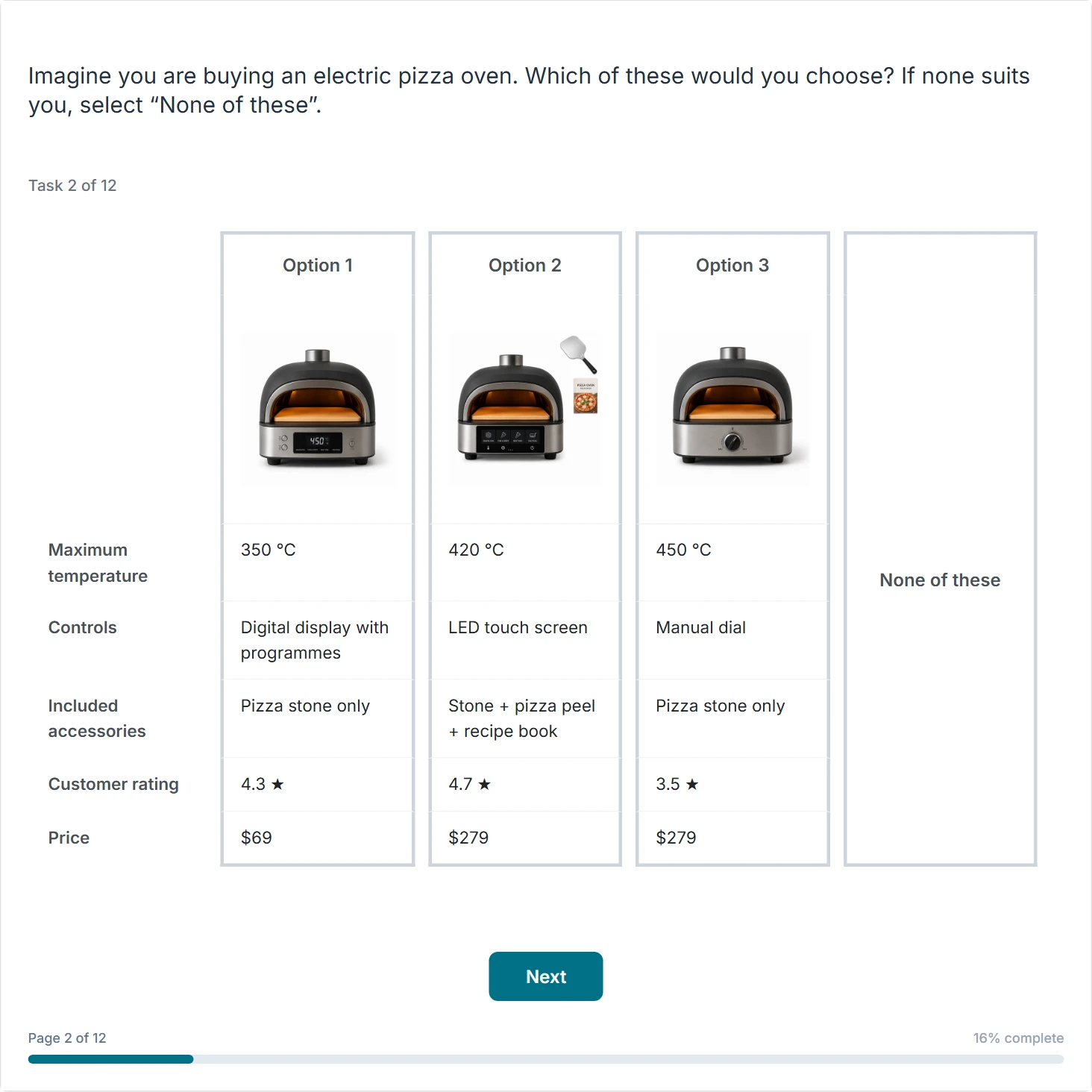
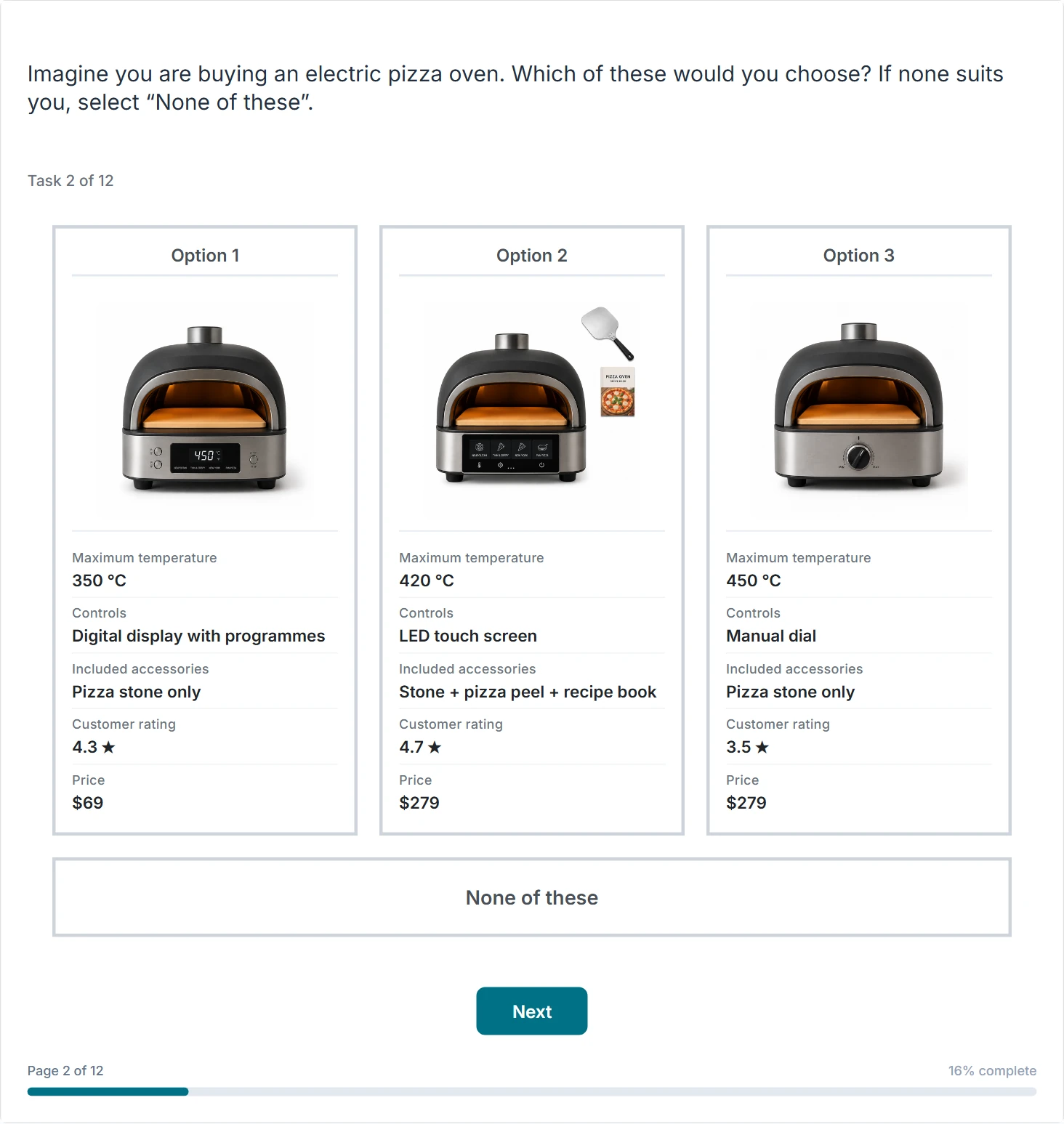
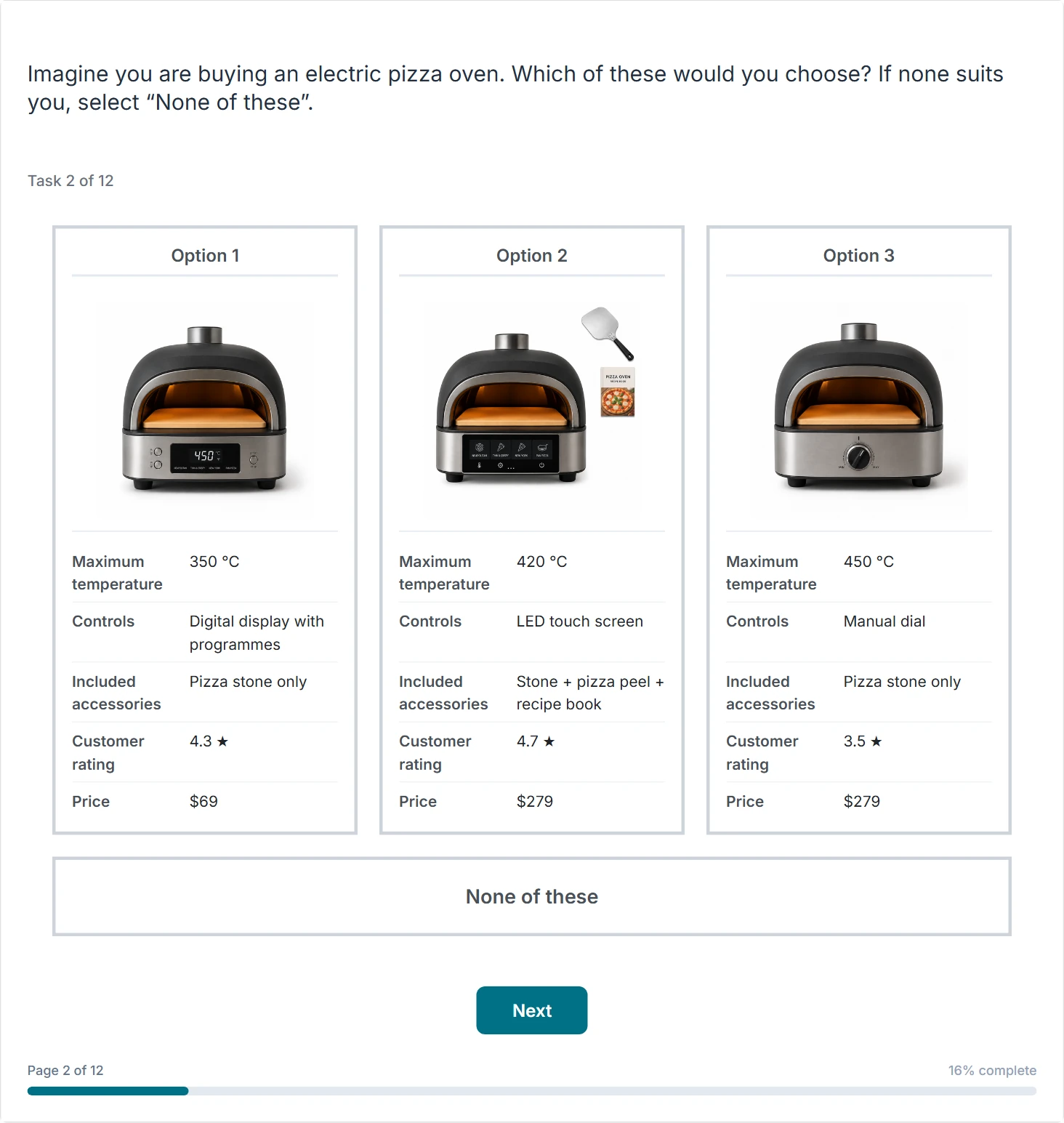
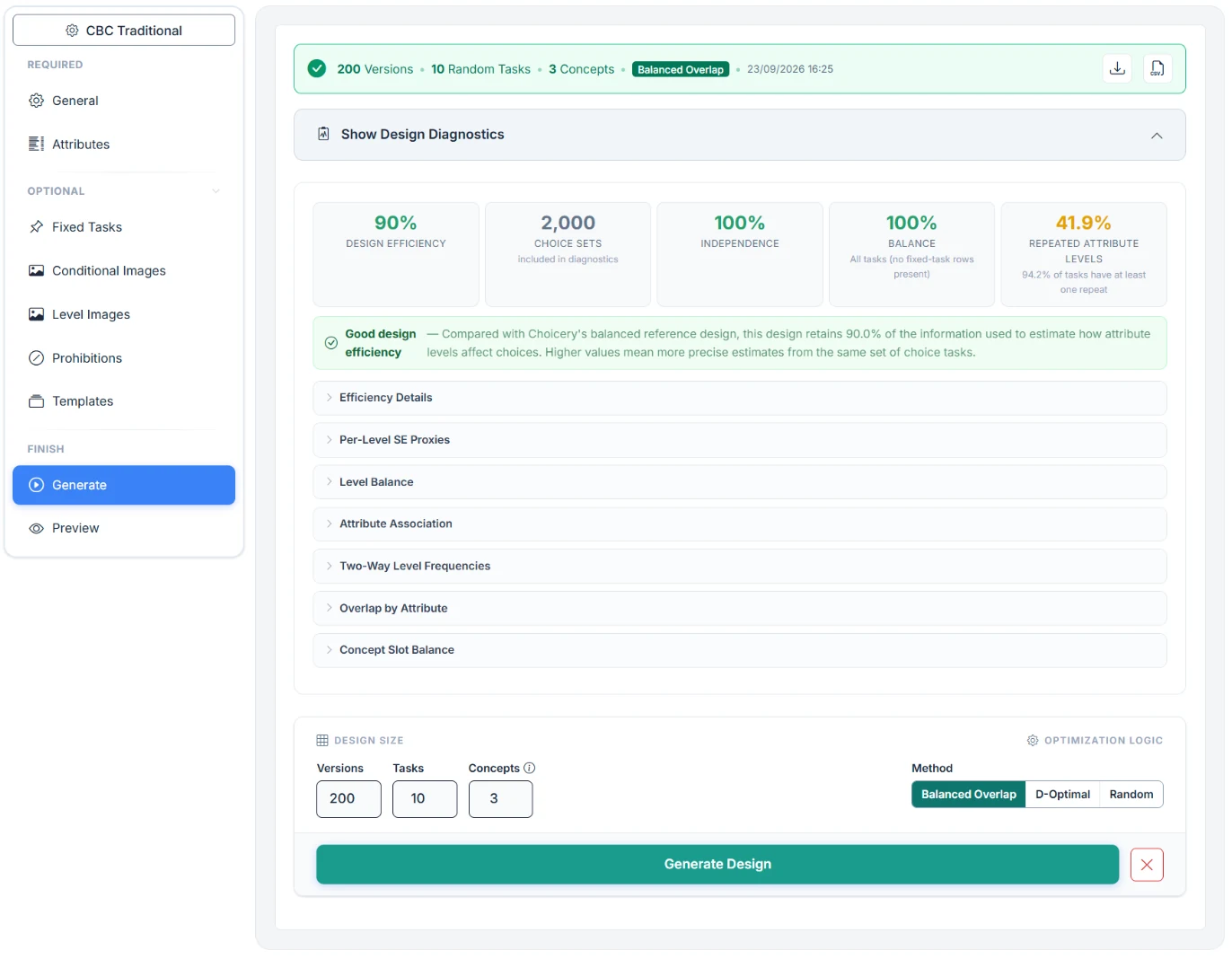
CBC is also known as a discrete choice experiment (DCE), and Choicery lets you run one yourself, DIY, from design to analysis. Respondents pick the best of two to four product concepts shown side by side, task after task. Because they choose rather than rate, there is no scale-use bias, and the design (Balanced Overlap by default, D-optimal on request) is efficient enough to recover a full utility profile for every respondent by Hierarchical Bayes. It is the standard method for pricing and feature trade-offs and the basis for WTP and the market simulator.
Best for
- Pricing decisions and feature trade-offs
- Products described by 3 to 6 attributes with a few levels each
- Market share simulation of concrete configurations
Design and estimation follow the established CBC/HB literature (McFadden, 1974; Lenk et al., 1996) and track independent benchmark results at around r = 0.99. Full CBC guide.
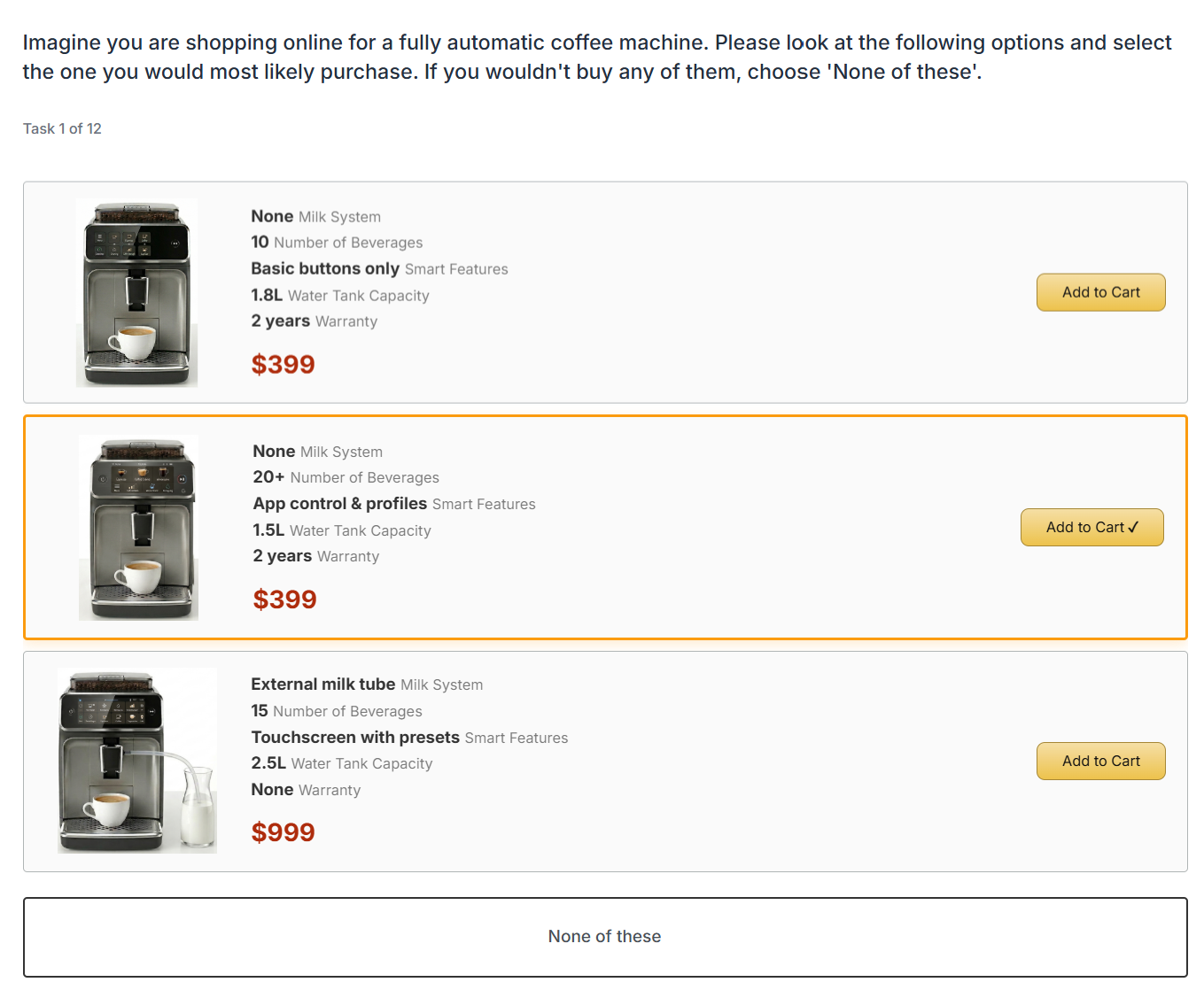
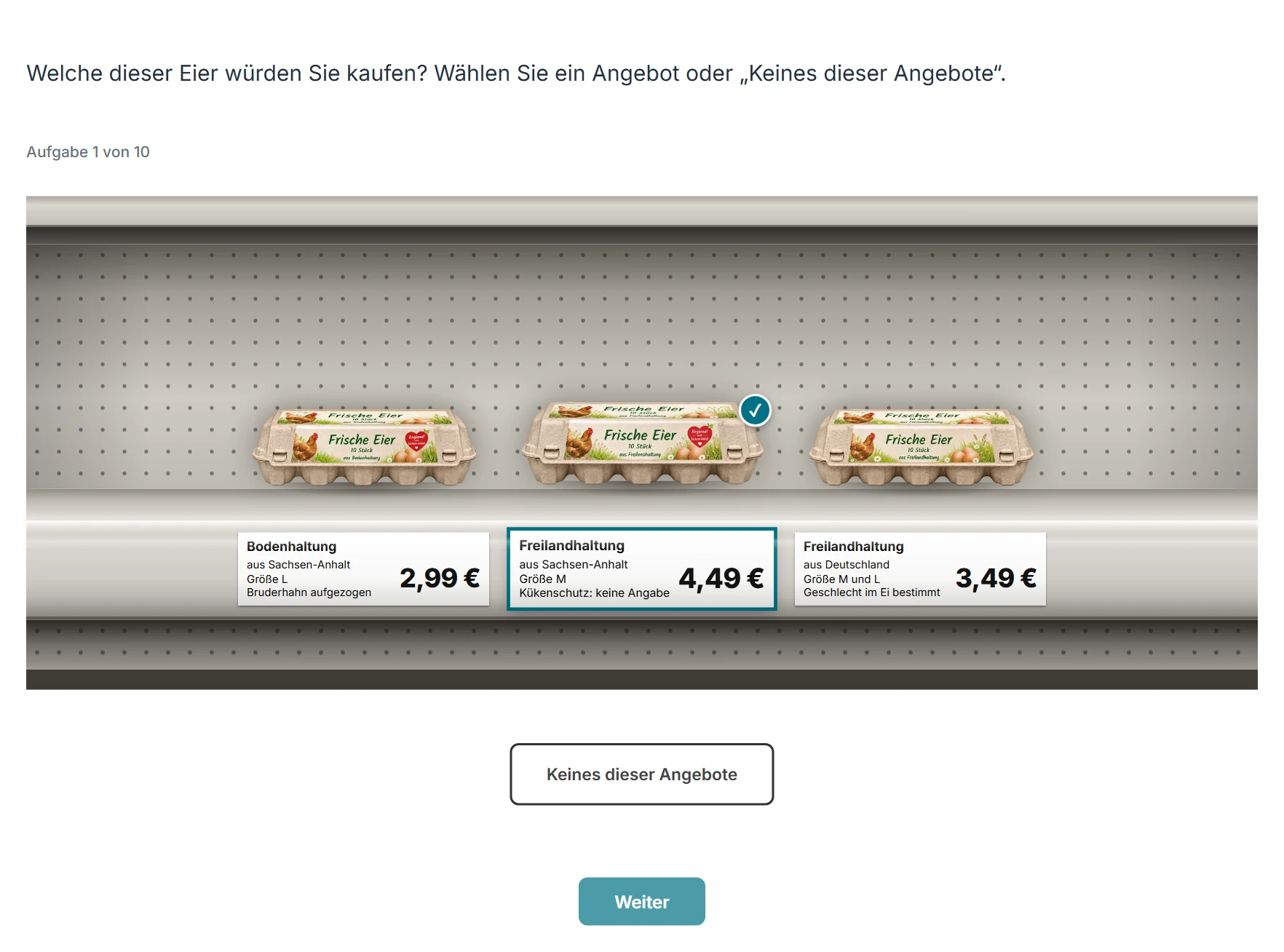
Two examples of five presentation modes. Customize the layout, products, images and styling for your study.
CBC Shop
The same CBC choice and the same estimation, dressed as a real purchase. Five presentation modes, from horizontal, vertical and grid cards to an immersive shelf or an online-shop layout with an add-to-cart button, so the task matches the channel respondents actually buy in. The idea is ecological validity (Brunswik, 1956): the closer the stimulus is to the real decision, the more valid the preference data.
Best for
- FMCG on a shelf and e-commerce listings
- Categories where packaging, price tags or page layout are part of the decision
- Studies that also need prohibitions or price that adjusts with the configuration
Runs through the identical CBC/HB math, only the presentation changes. Full CBC Shop guide.


DR-CBC (Dual-Response CBC)
Forced choice plus a "would you actually buy this?" follow-up on the chosen concept. The no answers create a genuine no-purchase outcome, so Hierarchical Bayes estimates a none utility alongside the part-worths and you can talk about category demand and market size, not just relative preference. Available in Integrated mode (follow-up on the same page) and Two-Block mode (all choices first, buy questions in a separate block), the latter giving the more stable WTP (Schlereth & Skiera, 2017).
Best for
- Willingness-to-pay studies and market sizing
- New products where "would anyone buy at all?" is a real question
- Markets where walking away is a realistic outcome
Tracks independent dual-response benchmark results closely, with the none parameter itself near r = 0.996. Full DR-CBC guide.


BW-CBC (Best-Worst CBC)
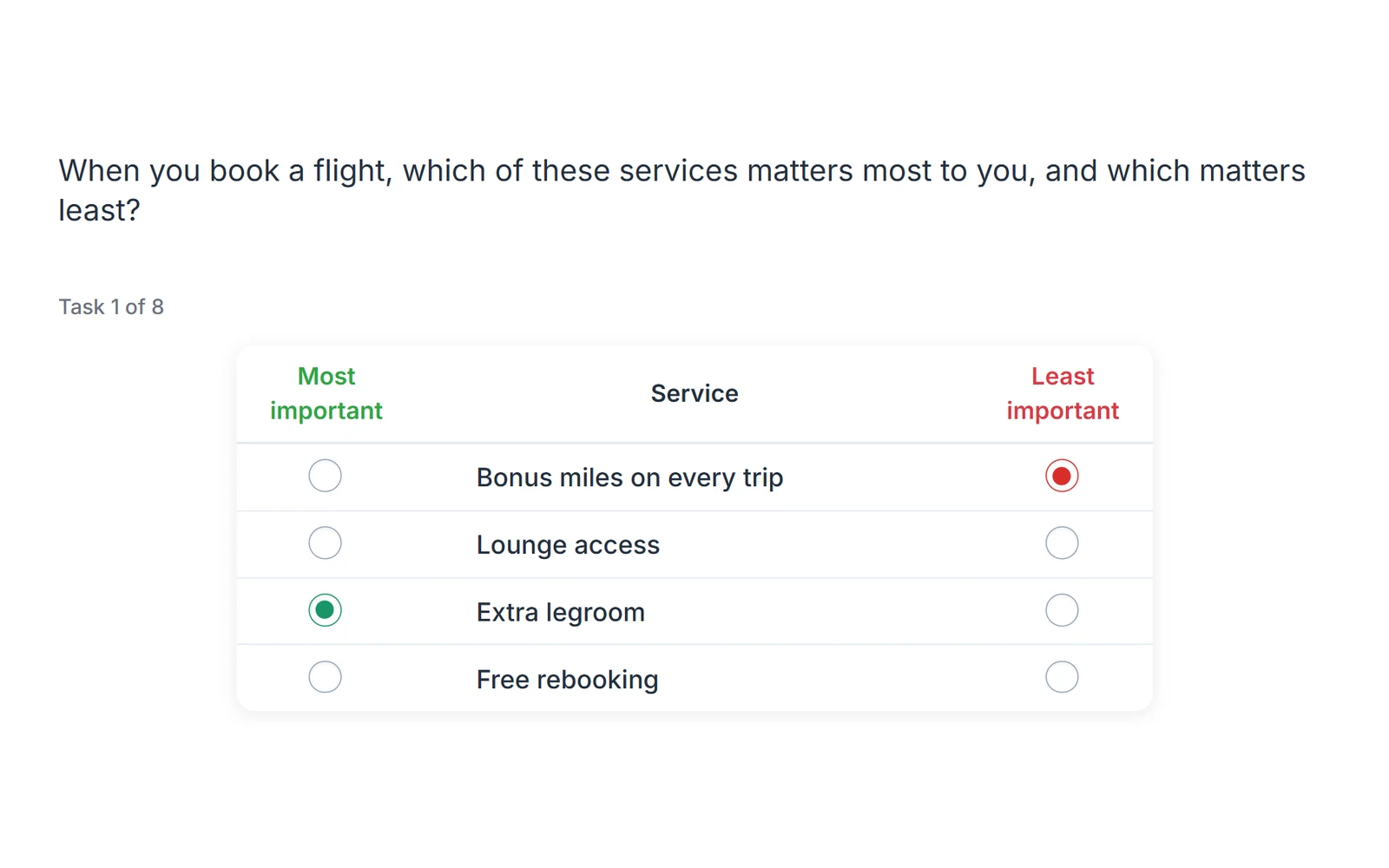
Respondents mark both the most and the least preferred concept in every task, which splits each task into two observations and roughly doubles the preference signal per respondent, so you get the same precision from fewer tasks, or tighter estimates at the same length. Formally the multi-profile case of best-worst scaling, estimated with a sequential best-worst logit (Marley & Louviere, 2005). Supports the same Integrated and Two-Block dual-response options as DR-CBC.
Best for
- Smaller samples that still need stable estimates
- Three or four concepts per task, where the worst pick is genuinely informative
- Studies where the rejected option is as telling as the chosen one
Two ways to ask "would you actually buy this?"
A no-buy option turns a choice experiment into a willingness-to-pay study. Choicery ships both established designs, in DR-CBC and in BW-CBC, and lets you switch with one click.
Integrated
Choice + follow-up on the same page
The buy/no-buy question appears next to the alternatives in every task. Familiar, fast to administer, what most platforms call "dual response".
Two-Block (Separated)
Forced choice first, buy/no-buy at the end
All forced-choice tasks are answered first. A second block then revisits the chosen products and asks the buy/no-buy decision separately, so it never bleeds back into the preference estimates.
Schlereth and Skiera (2017) put both designs head to head and looked at how willingness-to-pay behaves over the course of a survey. When the buy/no-buy question sits inside every choice task, WTP tends to drift downward as respondents move through the survey. When the buy/no-buy questions live in their own block at the end, that drift disappears. Integrated is quicker for respondents; Two-Block tends to give the more stable WTP number. Schlereth, C., & Skiera, B. (2017). Two new features in discrete choice experiments to improve willingness-to-pay estimation. Management Science, 63(3), 829-842.
Ranking a list instead of products
MaxDiff and Anchored MaxDiff answer a different question than conjoint: not which product wins, but which features, claims or messages matter most.
MaxDiff
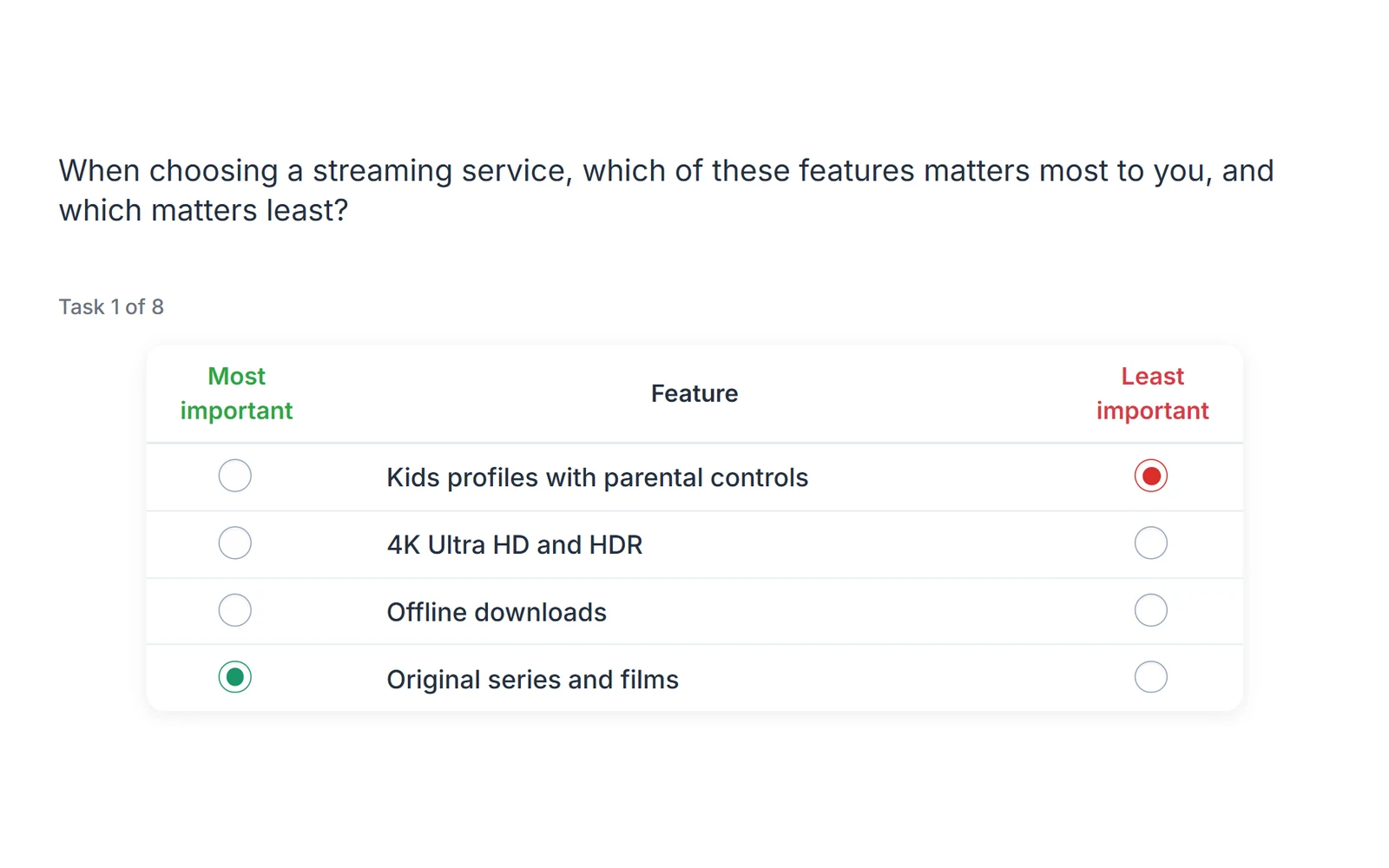
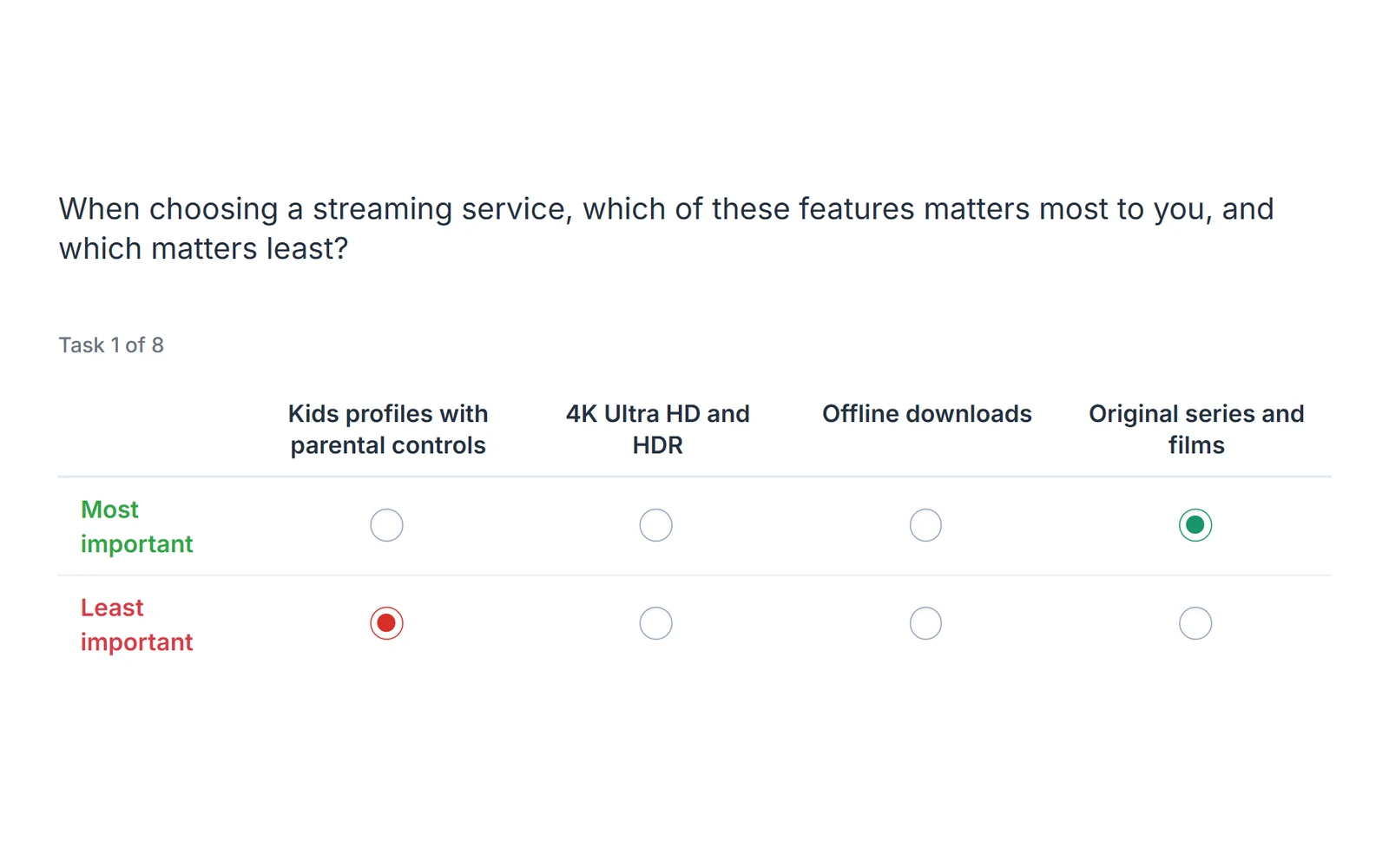
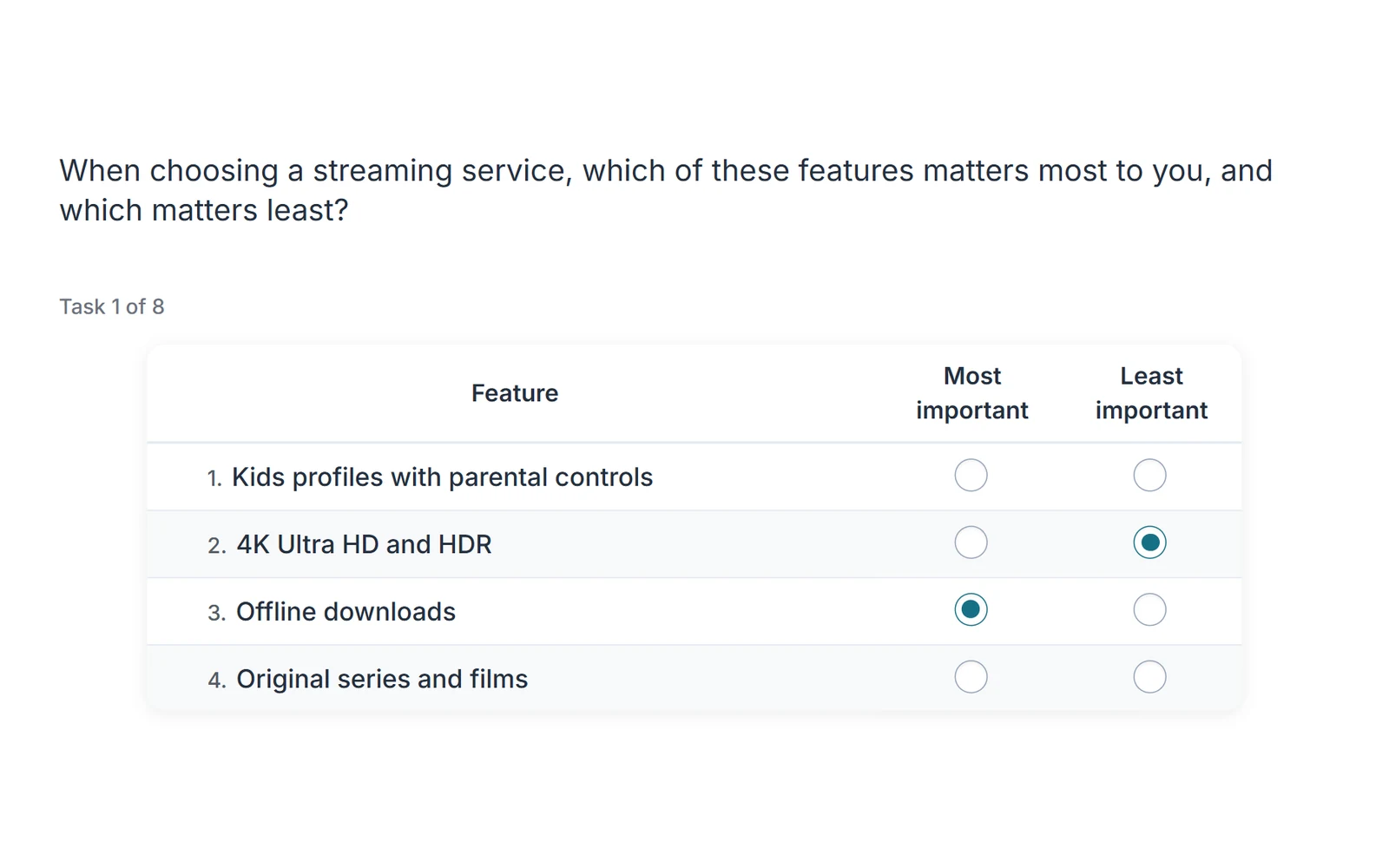
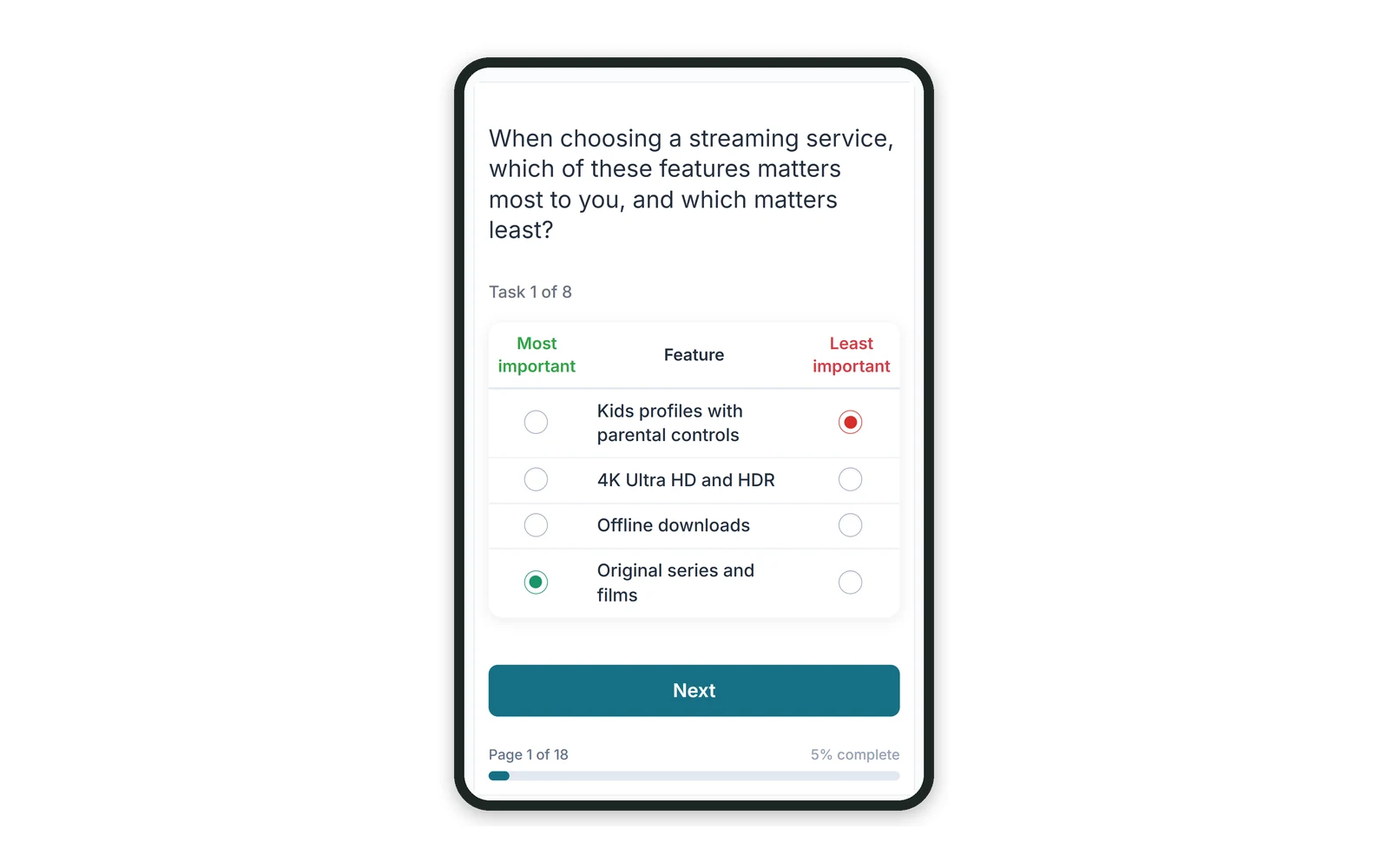
Best-worst scaling: respondents repeatedly pick the most and the least preferred item from a short subset. Each answer pins down several comparisons at once, so a balanced design ties the whole list together and Hierarchical Bayes returns a score for every item, per respondent. Scores come on three scales, including a ratio-scaled probability scale where a 20 is genuinely twice a 10. Far more discriminating than rating scales, which pile up at the top and drown in ties.
Best for
- Prioritizing 10 to 30 features, claims or messages
- UX and product roadmap decisions
- Message and concept ranking before a campaign
Feeds the MaxDiff Simulator for TURF reach analysis, which set of items appeals to the most people. Full MaxDiff guide.
Anchored MaxDiff
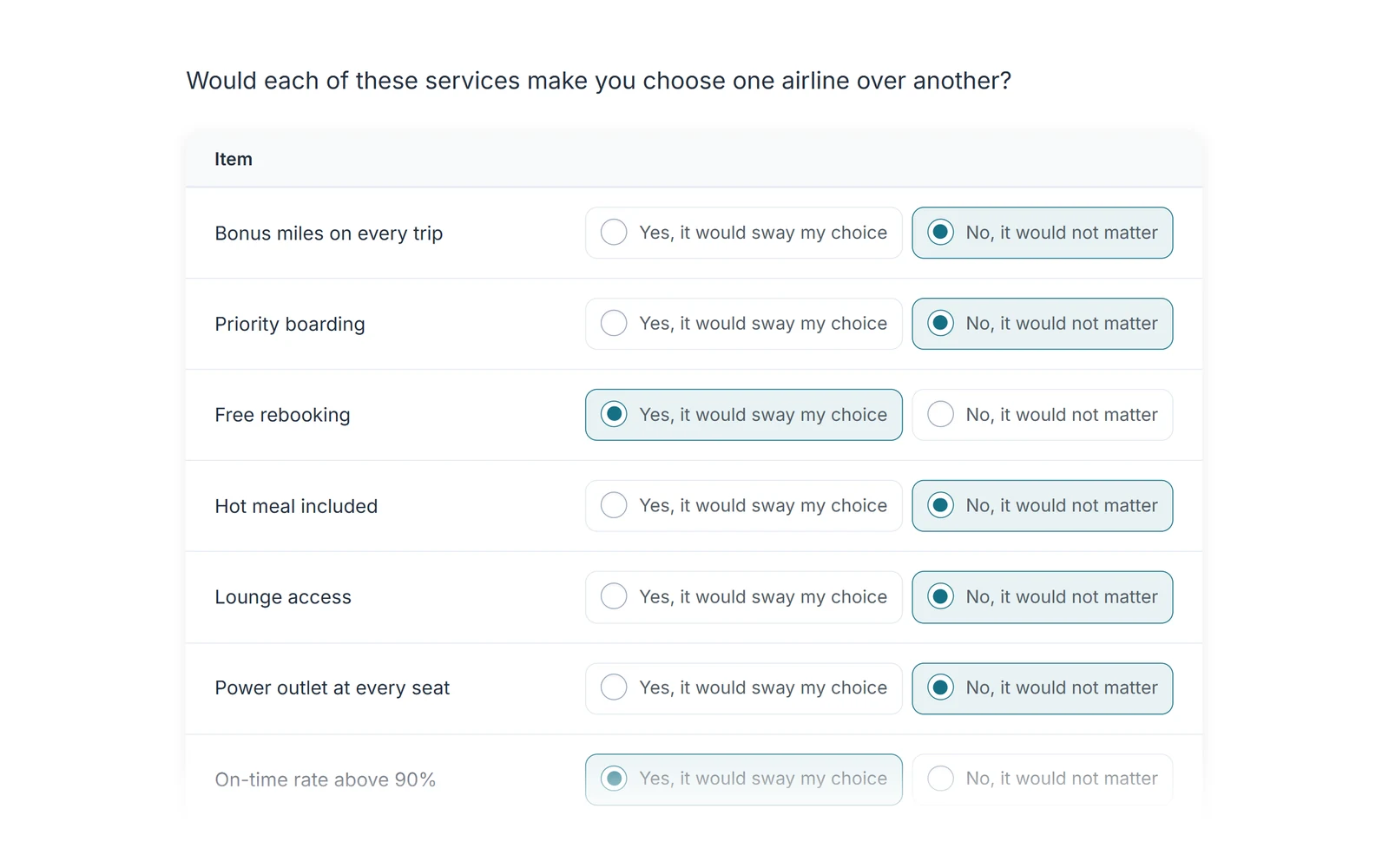
MaxDiff plus a calibration step. After the best-worst tasks, one extra screen asks a yes-or-no question about each item, which estimates a per-respondent threshold and shifts the scores onto an absolute axis: above the line is genuinely wanted, below it is not. You get a purchase probability and a consideration set per person, not just a ranking. Choicery uses the direct binary method (Lattery, 2010), the more conservative of the anchoring approaches.
Best for
- Separating must-haves from nice-to-haves against a real threshold
- Roadmaps where "top-ranked" is not enough to justify building
- Pairing with TURF to find the smallest set that still clears the bar for most people
Run your next conjoint study in Choicery
Try the full platform for free, and upgrade when your study needs more respondents.
No credit card required · Up to 50 respondents free · No fixed term