Kano, Van Westendorp and Gabor-Granger, built in
The market-research classics are native Choicery items: add them to any survey like a Likert question, and each one arrives with its standard analysis. No spreadsheet gymnastics after fieldwork.
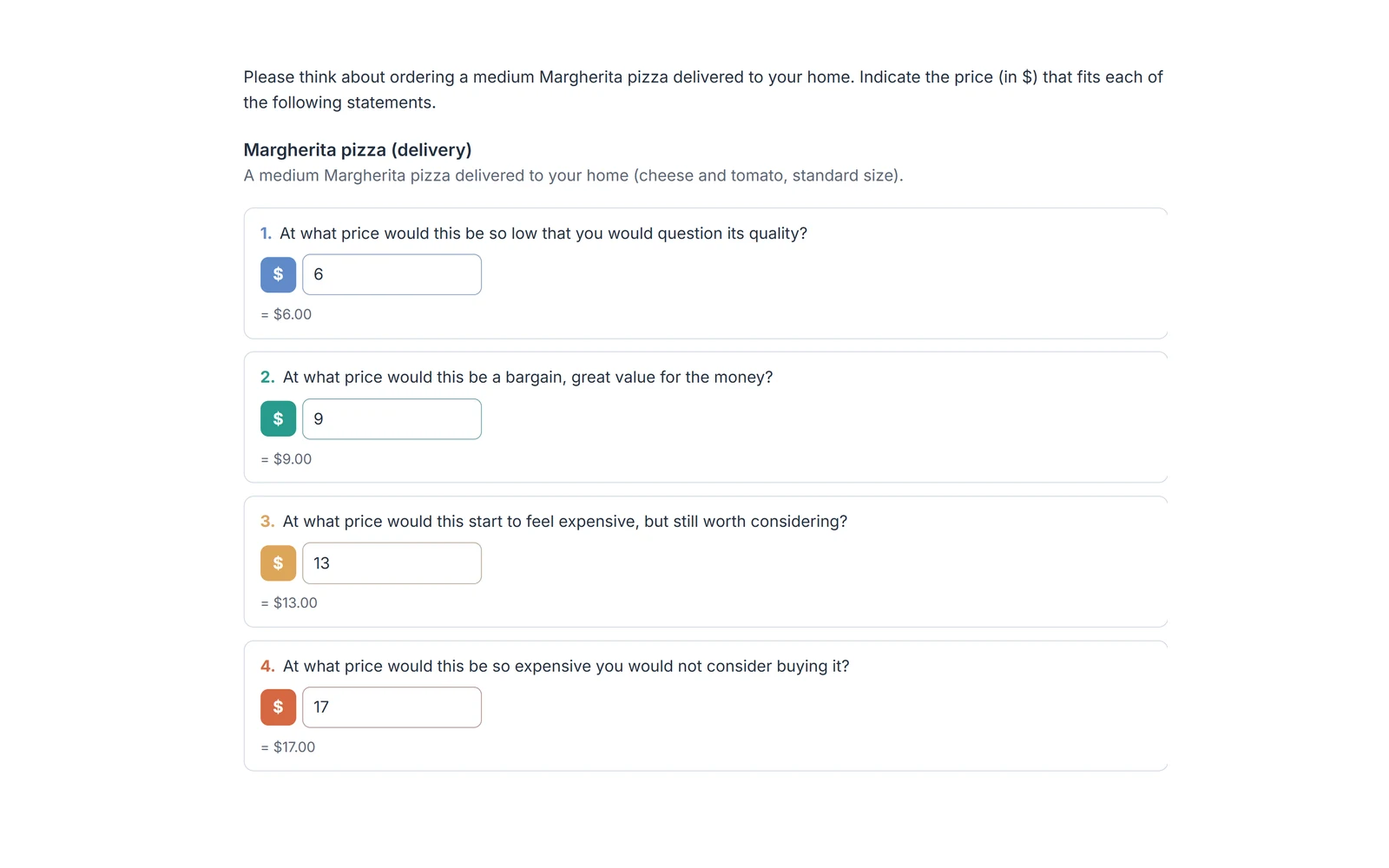
Van Westendorp (Price Sensitivity Meter)
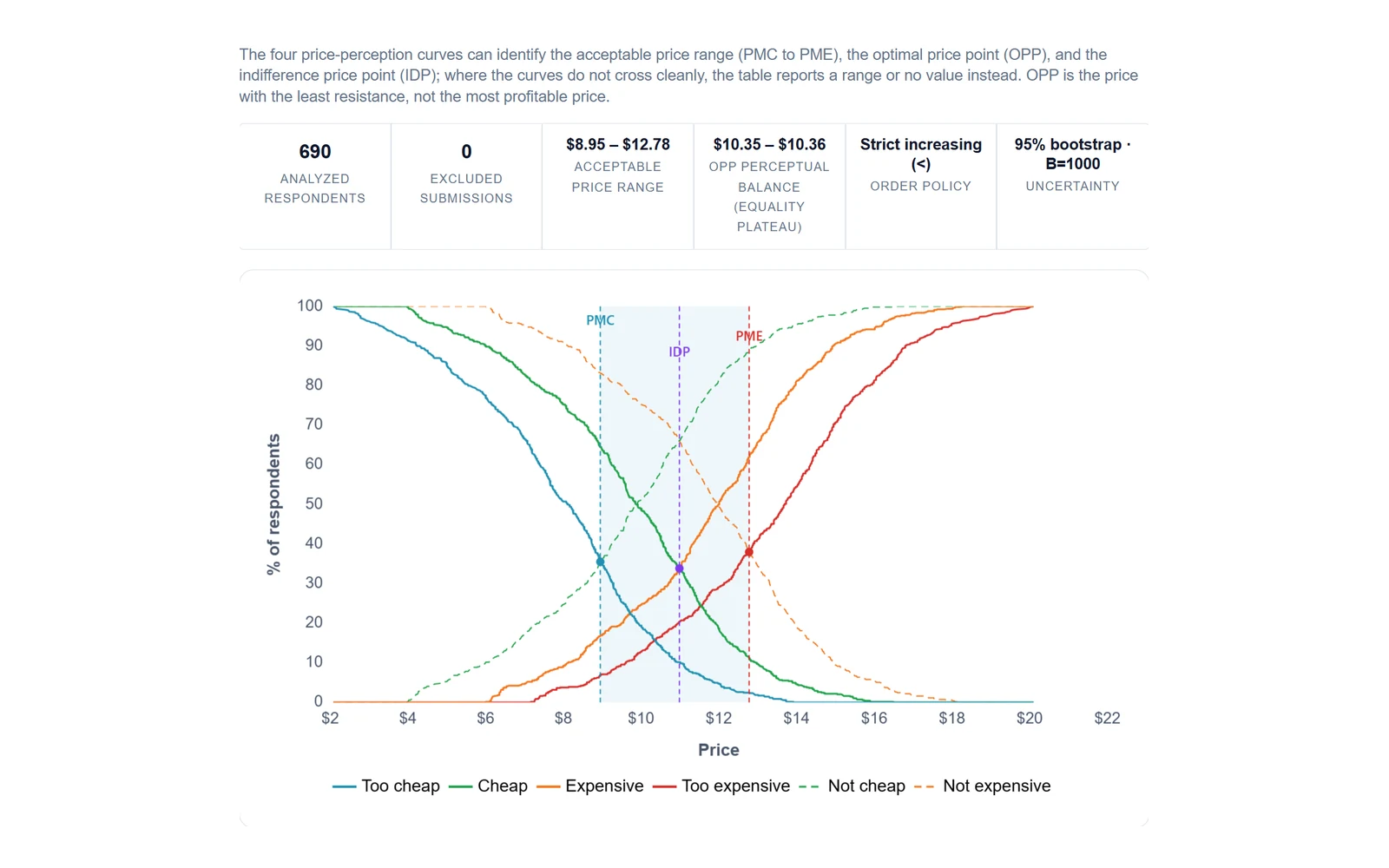
Four price questions per respondent produce cumulative perception curves. Choicery reports uniquely identified intersections as points and preserves equality plateaus as intervals, using the 1976 complement-curve range definition.
- PMC and PME: the lower and upper edge of the acceptable price range
- OPP: perceptual minimum-resistance balance, not a revenue or profit optimum
- IDP: as many find it cheap as expensive
- Shaded acceptable range only when PMC and PME are uniquely identified
- Optional Newton-Miller-Smith extension: two purchase questions at each respondent's own bargain and expensive price add a calibrated stated purchase likelihood and a revenue index; the weights are adjustable on the results page
- Optional qualifying question, so only likely buyers answer the price questions; the results show the qualified share
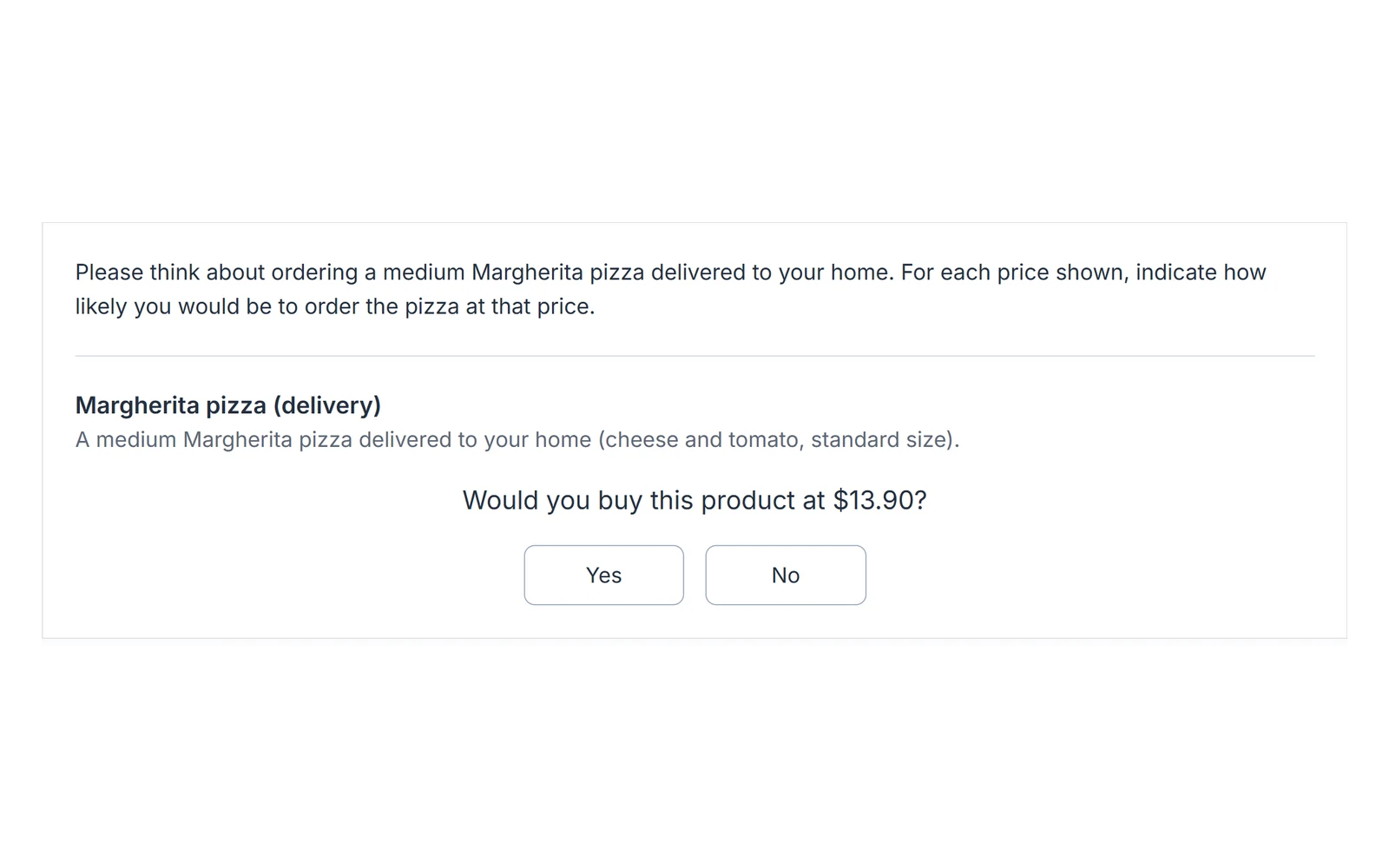
Gabor-Granger
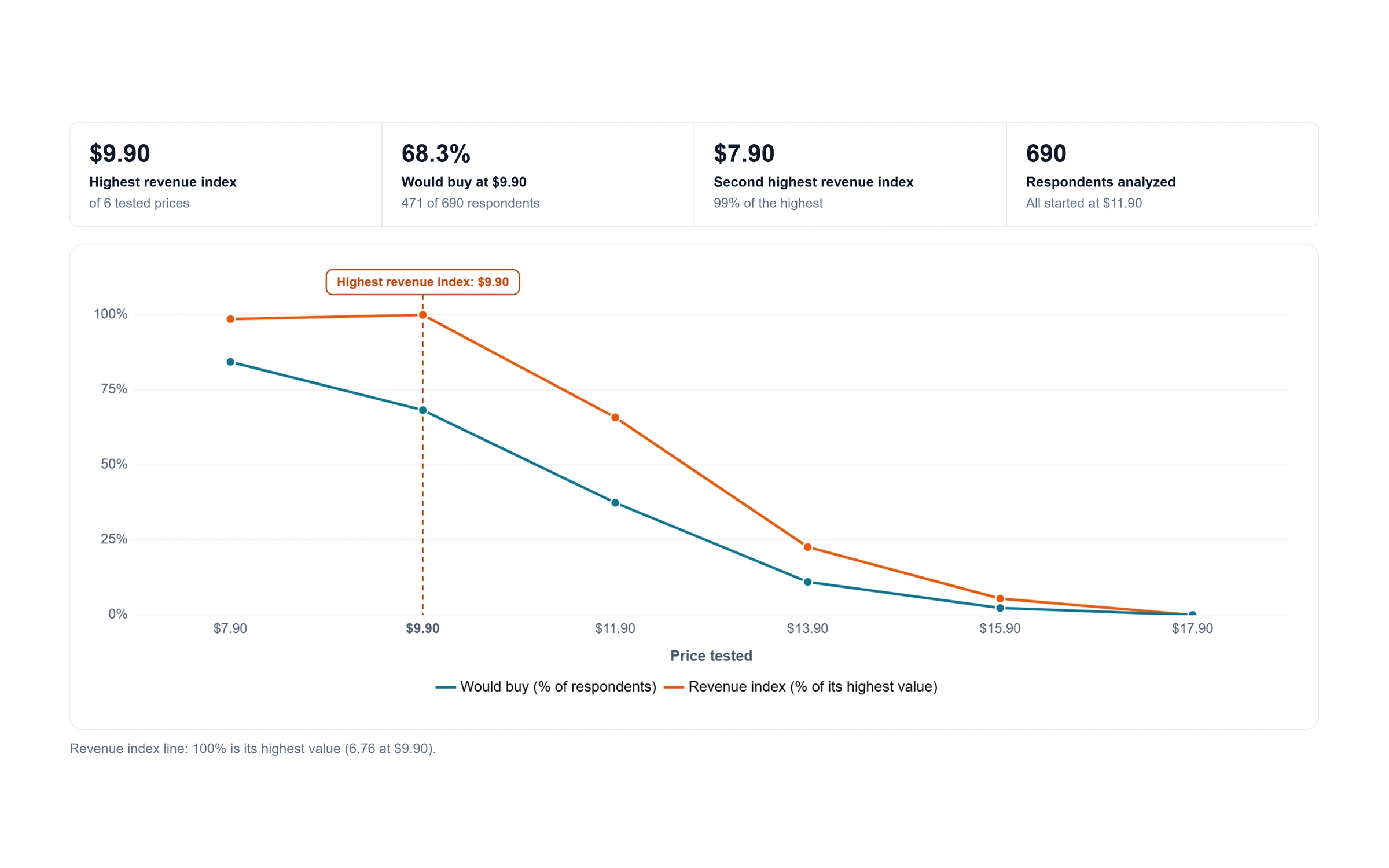
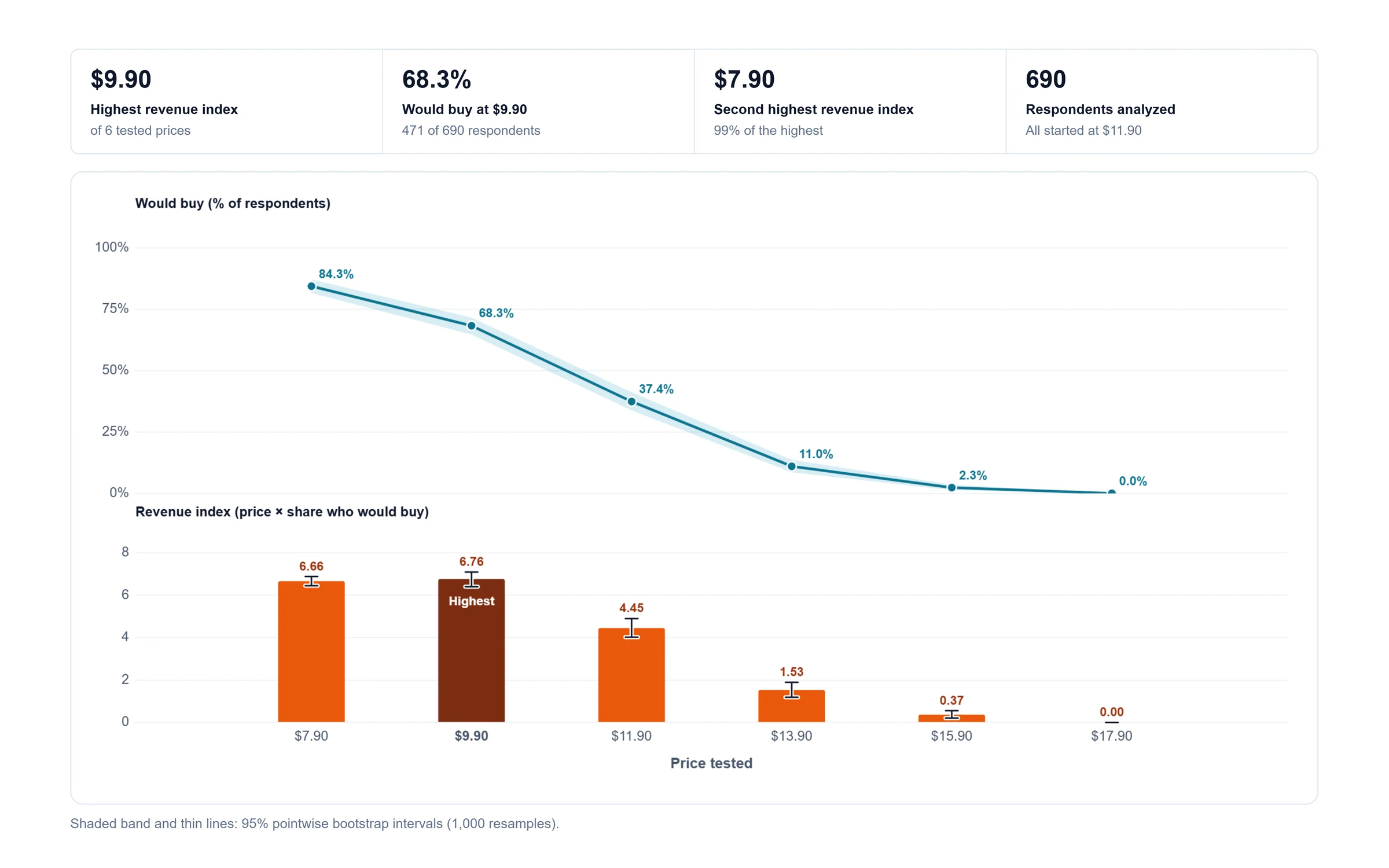
Gabor-Granger elicits stated purchase intent on a configured ladder of concrete prices. The analysis estimates the stated would-buy share and a revenue index (price × share) at each configured level. A single strongest tested level appears only when the complete ladder is estimable, stated demand is positive, and the maximum is unique.
- Estimated stated would-buy share across the configured price ladder
- Revenue index across the tested ladder, not a sales or profit forecast
- Yes/No or a 5-point purchase-intent scale; with 5 points you choose which answers count as buying and get a second, weighted purchase-likelihood curve
- Optional qualifying question, with demand shown among qualified respondents and among all respondents
- Directional pricing evidence for one fixed product concept
Kano
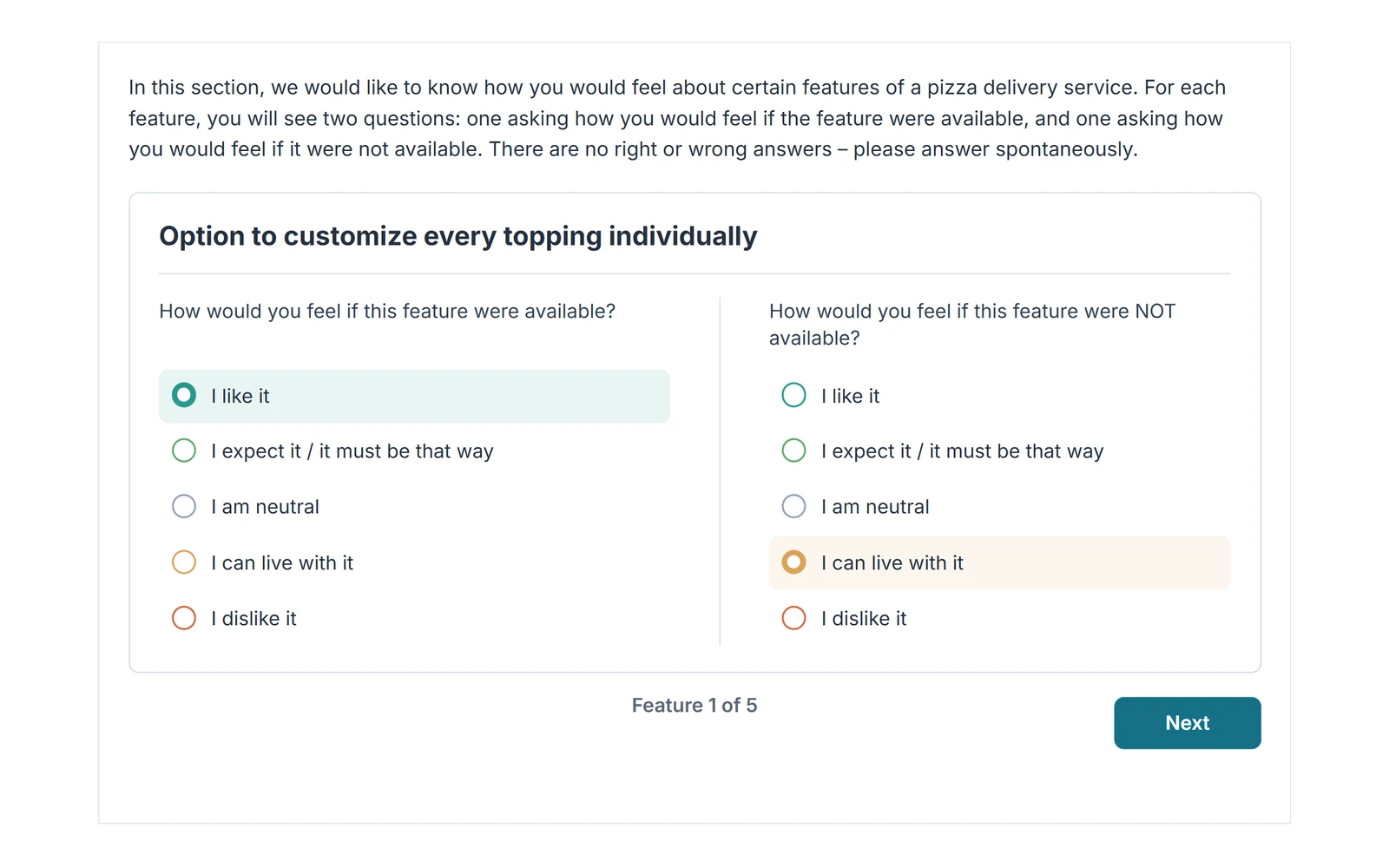
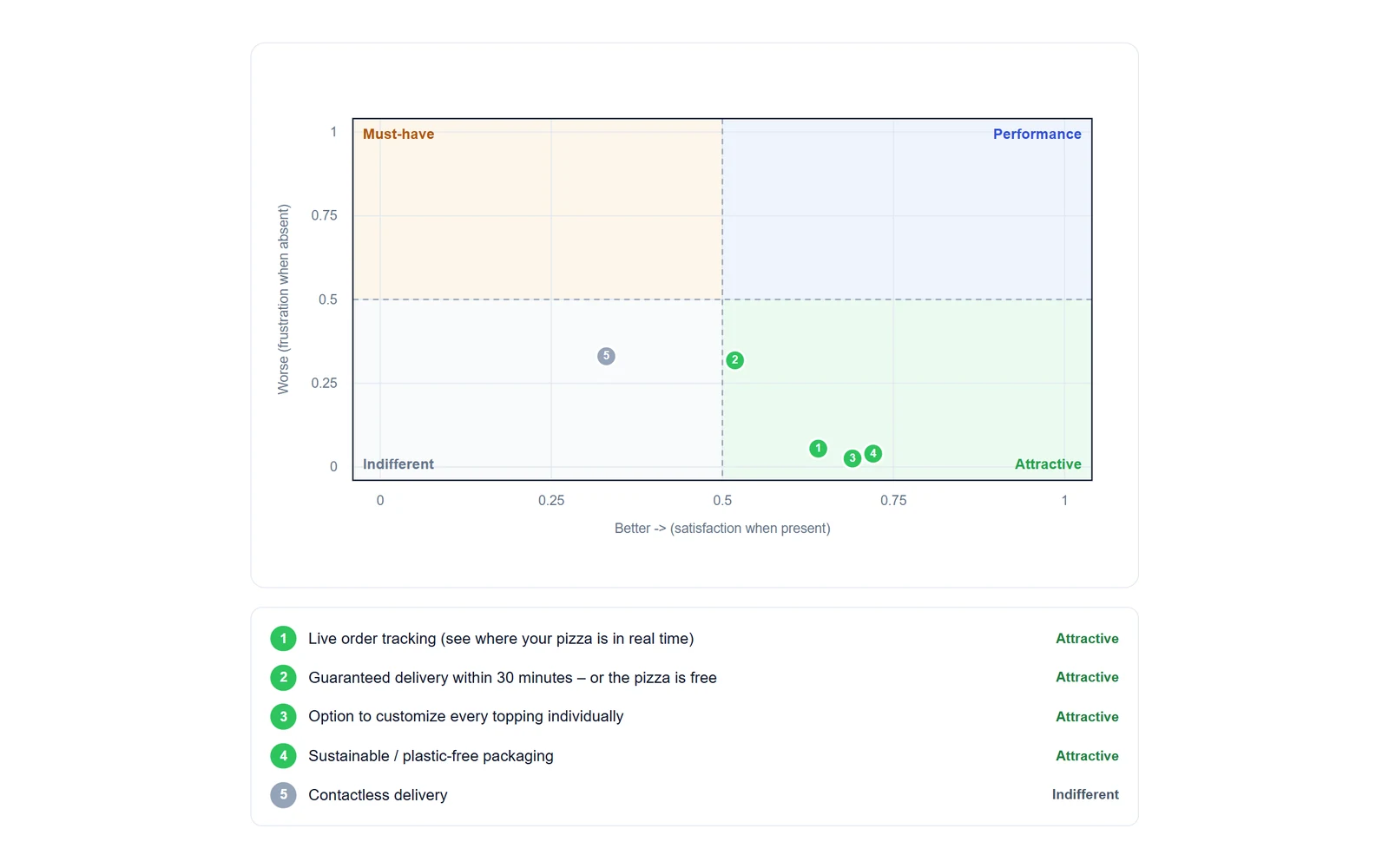
The classic paired questions (feature present vs. feature absent) classify every feature by its impact on satisfaction, so a roadmap is not built on "everything is important".
- Categories: Attractive, Performance, Must-have, Indifferent (plus Reverse and Questionable)
- Better/Worse chart positioning every feature at a glance
- Column or stacked question layout, your choice
Strong together
These methods provide focused single-product diagnostics for pricing perceptions, stated purchase intent, and feature classification. When the decision involves trade-offs between attributes, that is what CBC and MaxDiff are for, and all of them can live in the same survey: a Kano battery before the conjoint, a Van Westendorp block after it, one dataset at the end.
Every Kano, Van Westendorp and Gabor-Granger result can be split by a grouping variable: a question, a Latent Class segment or the experimental condition. Up to 12 groups appear side by side, each with its own n and 95% bootstrap intervals.
Run your next conjoint study in Choicery
Try the full platform for free, and upgrade when your study needs more respondents.
No credit card required · Up to 50 respondents free · No fixed term