From design studio to replication package
Five stages in one browser tab: survey building, estimation, market simulation, export, and the experimental design underneath. This page walks through each of them.
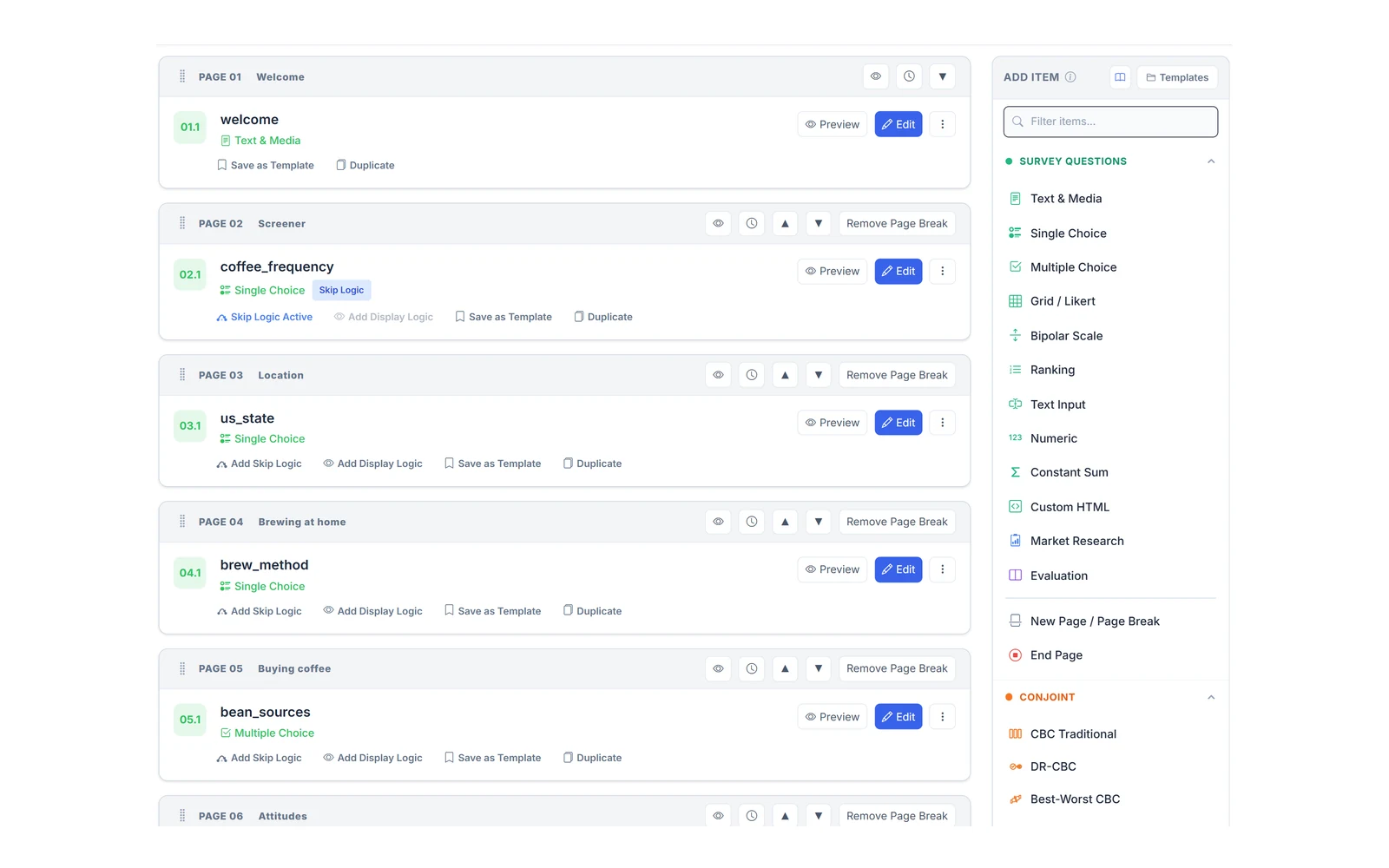
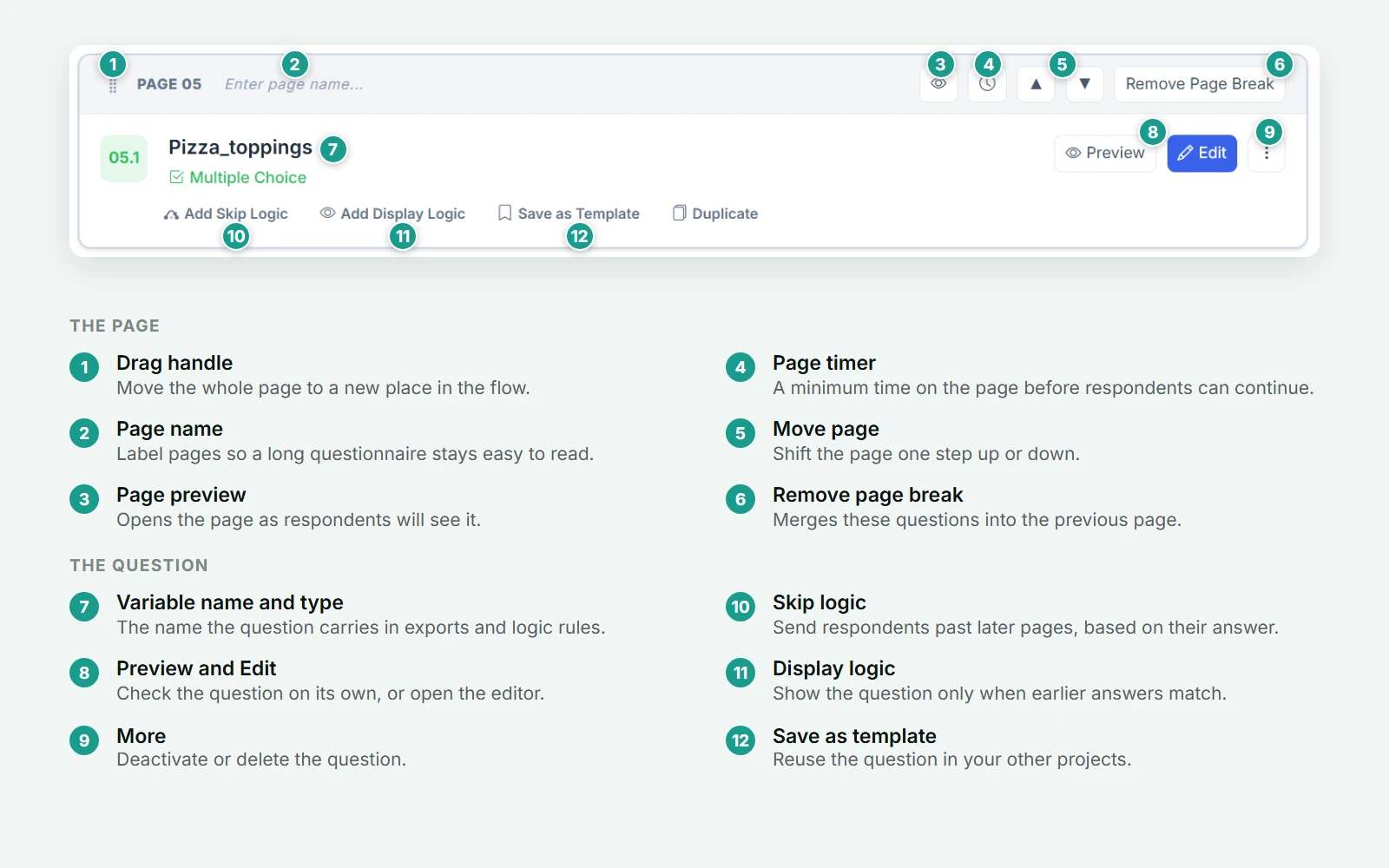
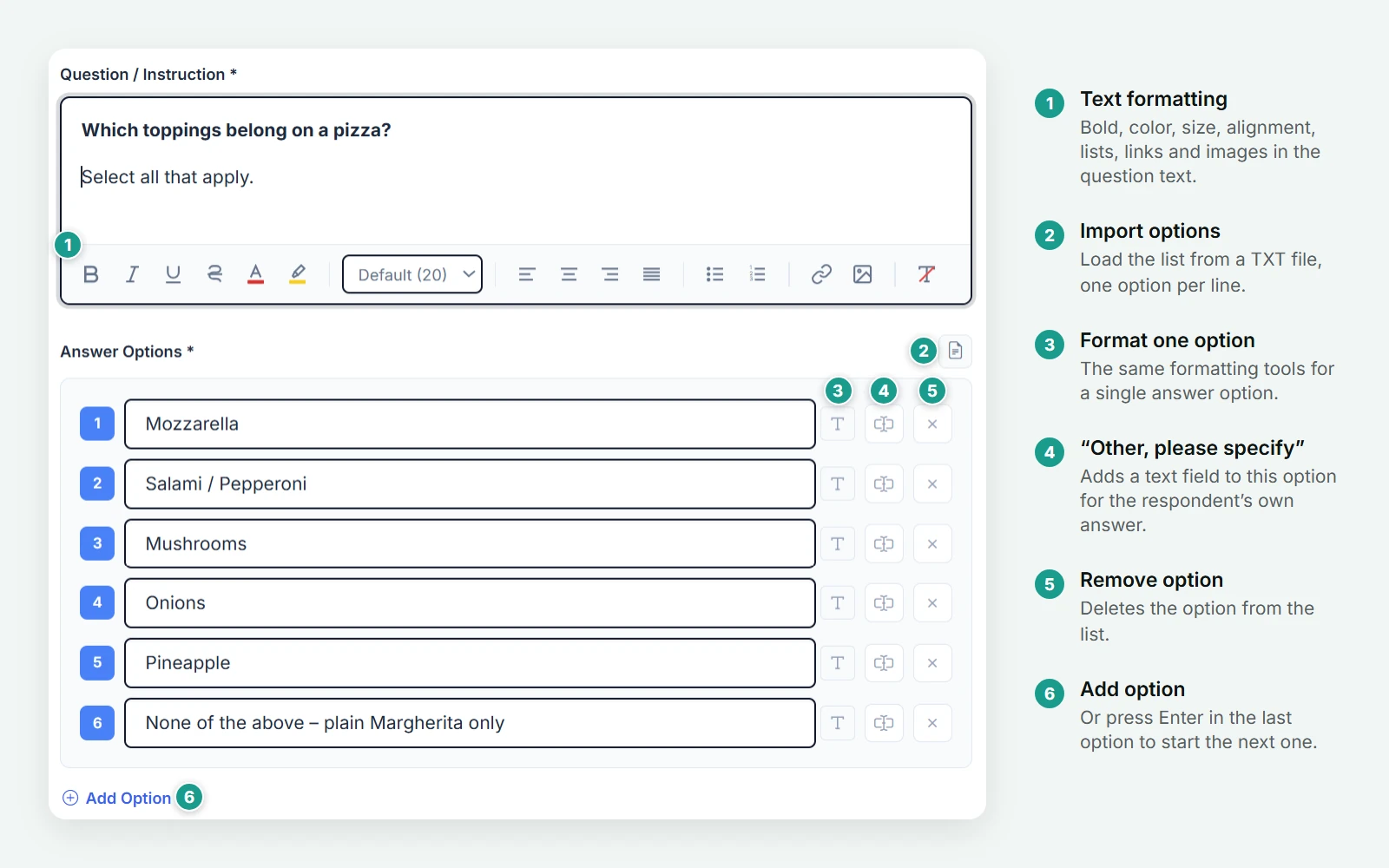
Survey Builder
Build the whole questionnaire around the conjoint task, standard questions and advanced logic, in one drag-and-drop flow. The full item library covers everything from Likert matrices to pricing methods.
- 15+ item types, plus Kano, Van Westendorp and Gabor-Granger
- Skip and display logic
- Randomization blocks and between-subjects designs
- Custom HTML for anything the built-in types do not cover
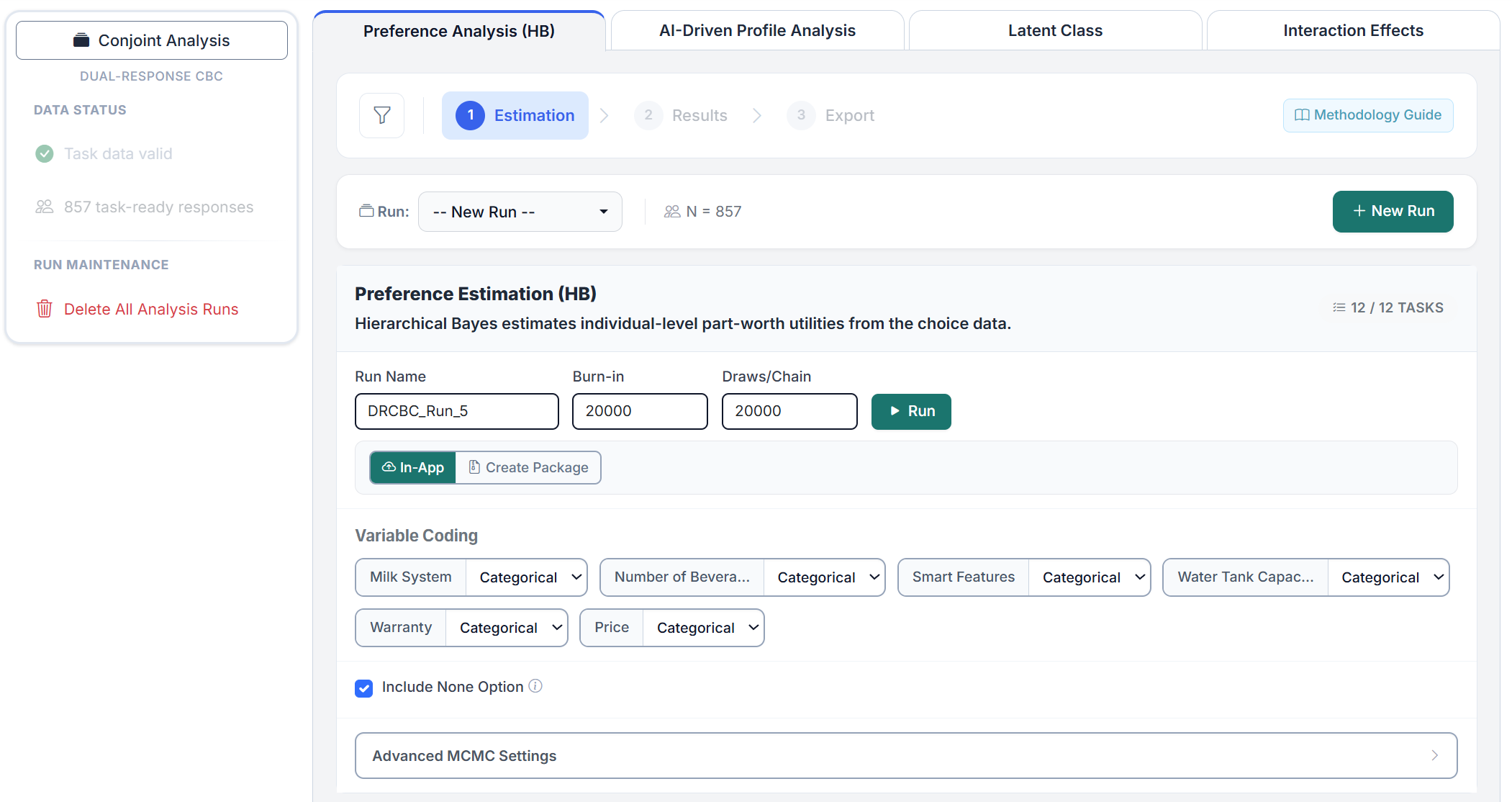
Know what every customer values
Choicery turns raw survey answers into clear, decision-ready numbers, so you can finally answer the questions your stakeholders actually ask.
- Which features drive the decision (attribute importance)
- What every individual respondent prefers, not just the average
- How much each feature is worth in real money (willingness-to-pay)
- How price changes shift demand (price sensitivity)
- Which products win, feeding straight into the market simulator
Under the hood: Choicery uses Hierarchical Bayes (HB), the industry-standard estimation method behind serious academic and commercial conjoint research. It runs on a fast Julia engine with full quality checks built in, so you get trustworthy, individual-level results without having to touch the statistics yourself.
The market simulator
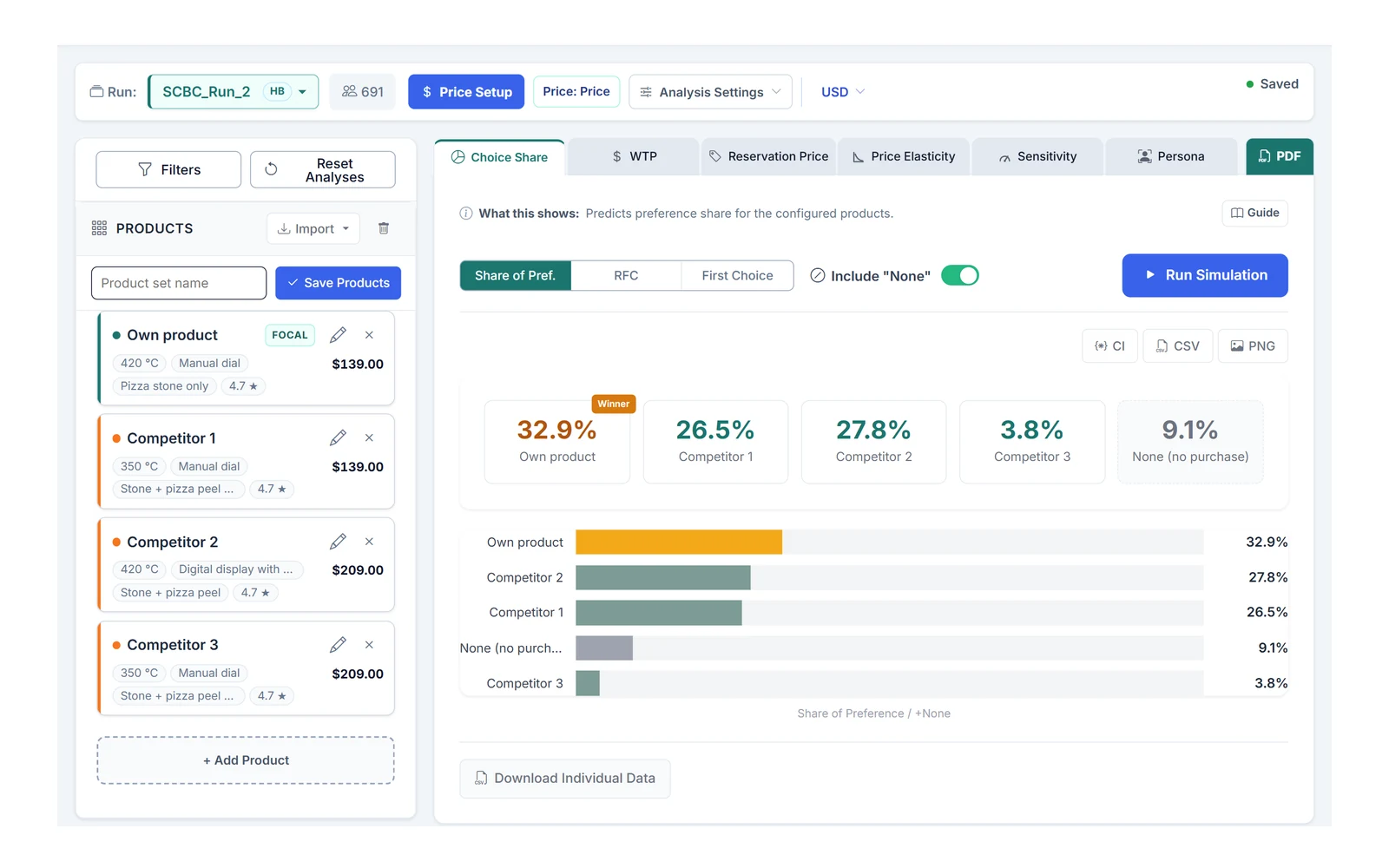
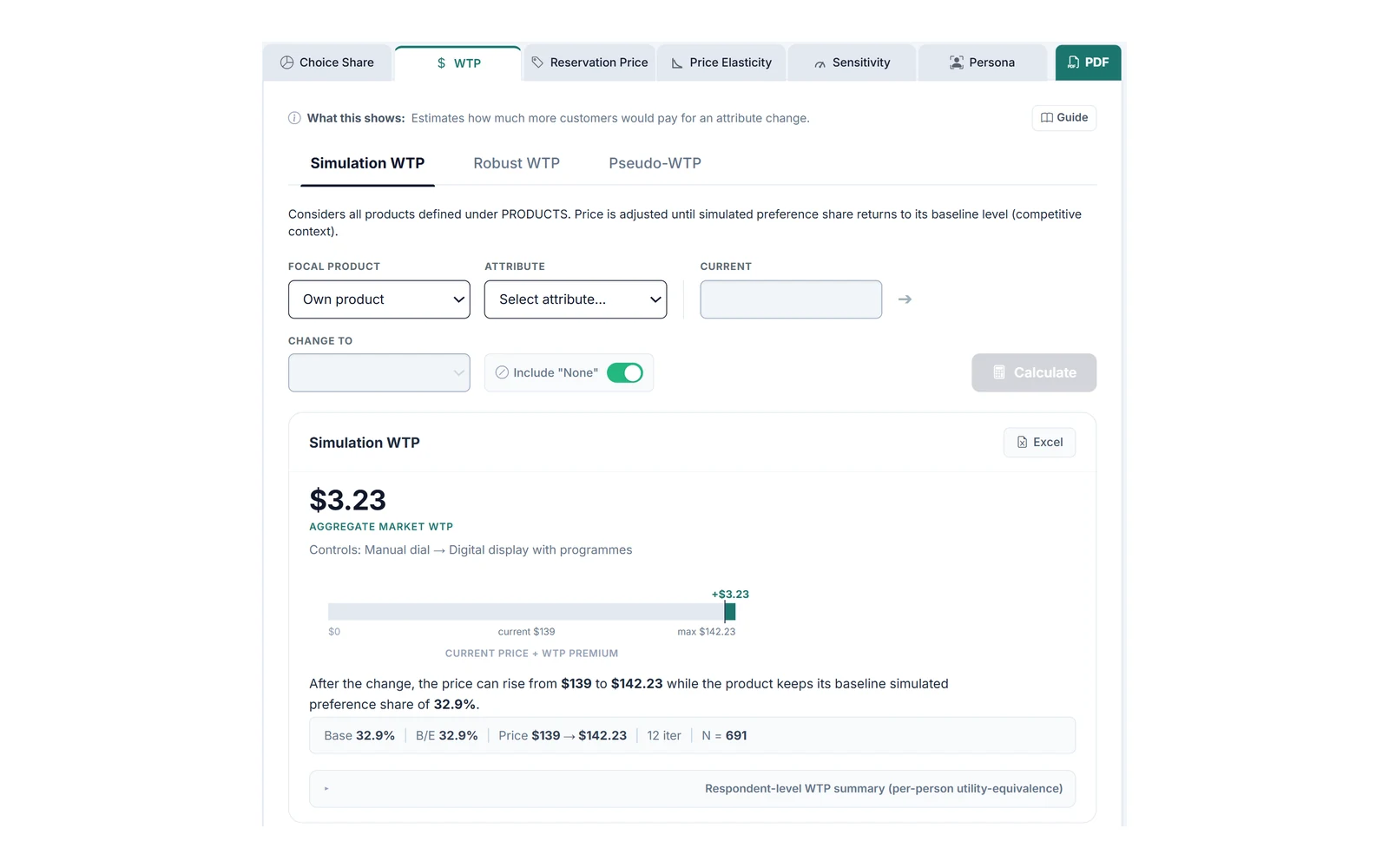
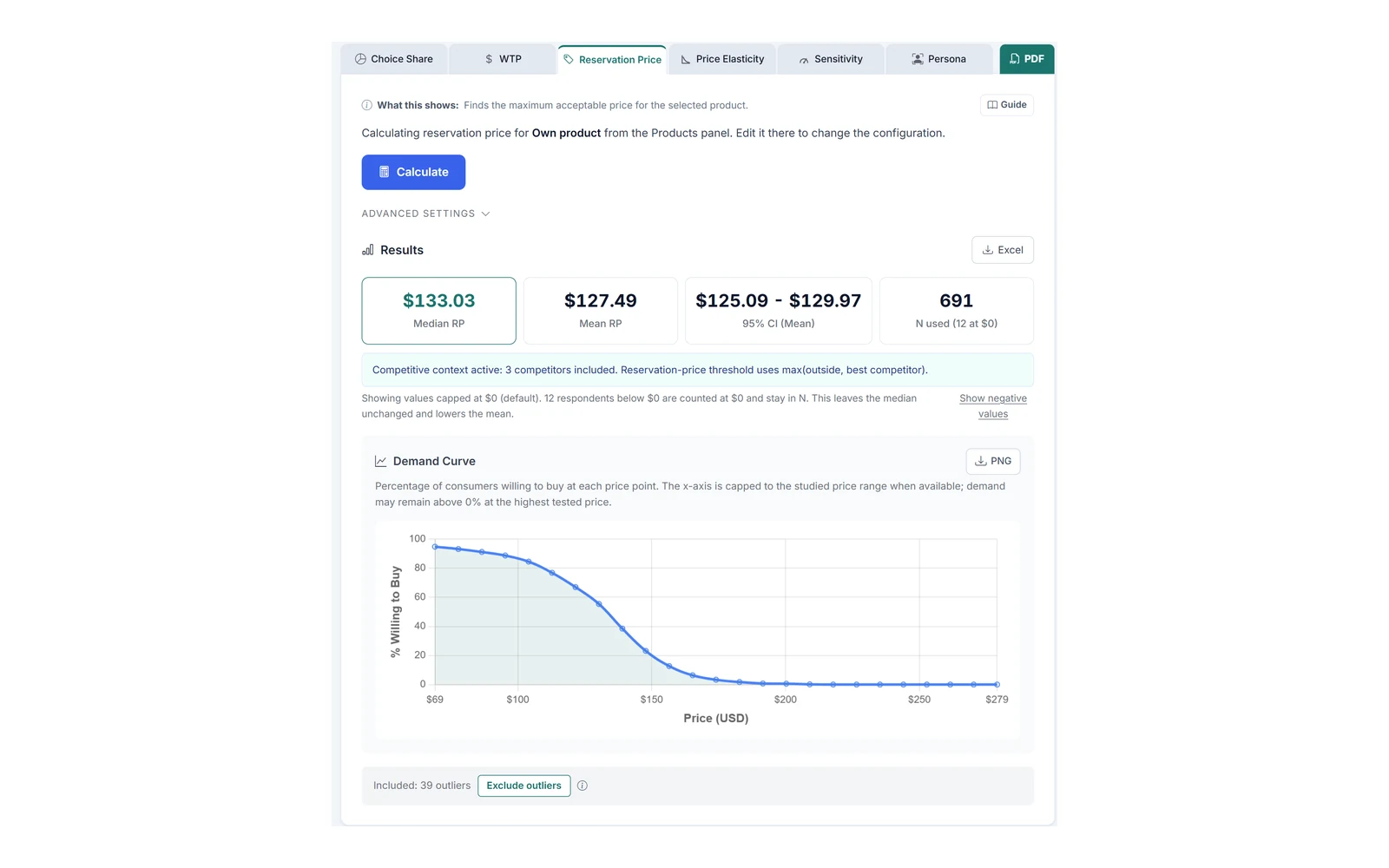
Utilities are the engine; the simulator is the steering wheel. Configure products, put them in competition, and read the predicted choice shares, then answer the "what if" questions stakeholders actually ask. It is a whole workbench of tools, not one chart, each one shown on the Market Simulation page.
- Choice share by three rules: First Choice, Share of Preference, and Randomized First Choice with a similarity correction for near-identical products
- Willingness to pay, including a bootstrap method that reports a median with confidence intervals across hundreds of competitive scenarios
- Own-price and cross-price elasticity, with demand curves
- Reservation price, sensitivity analysis and persona simulation after an AI-Driven Profile Analysis run
- Segment filters on up to five survey variables, and saved product sets you can load again
Reports & Full Replication
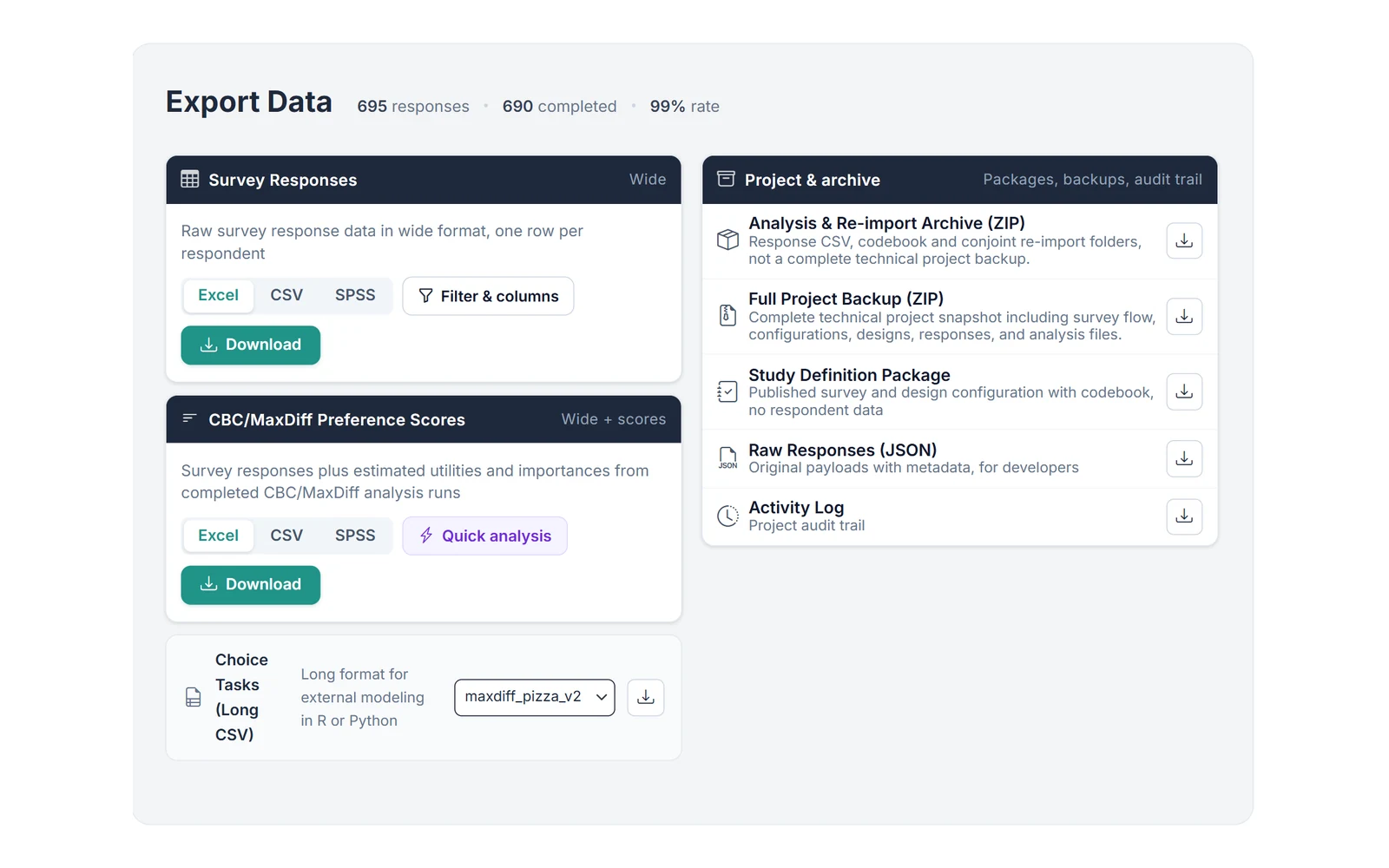
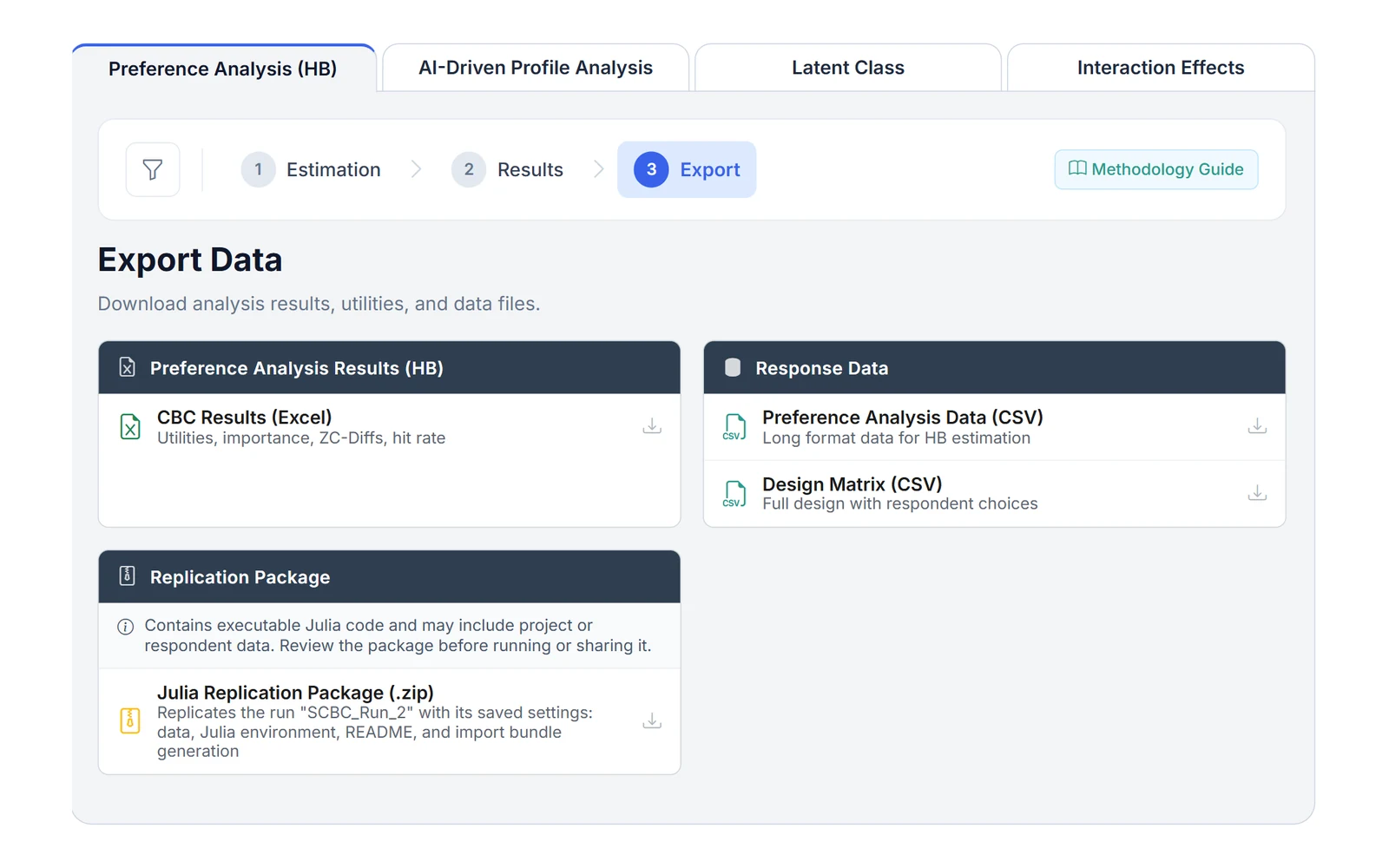
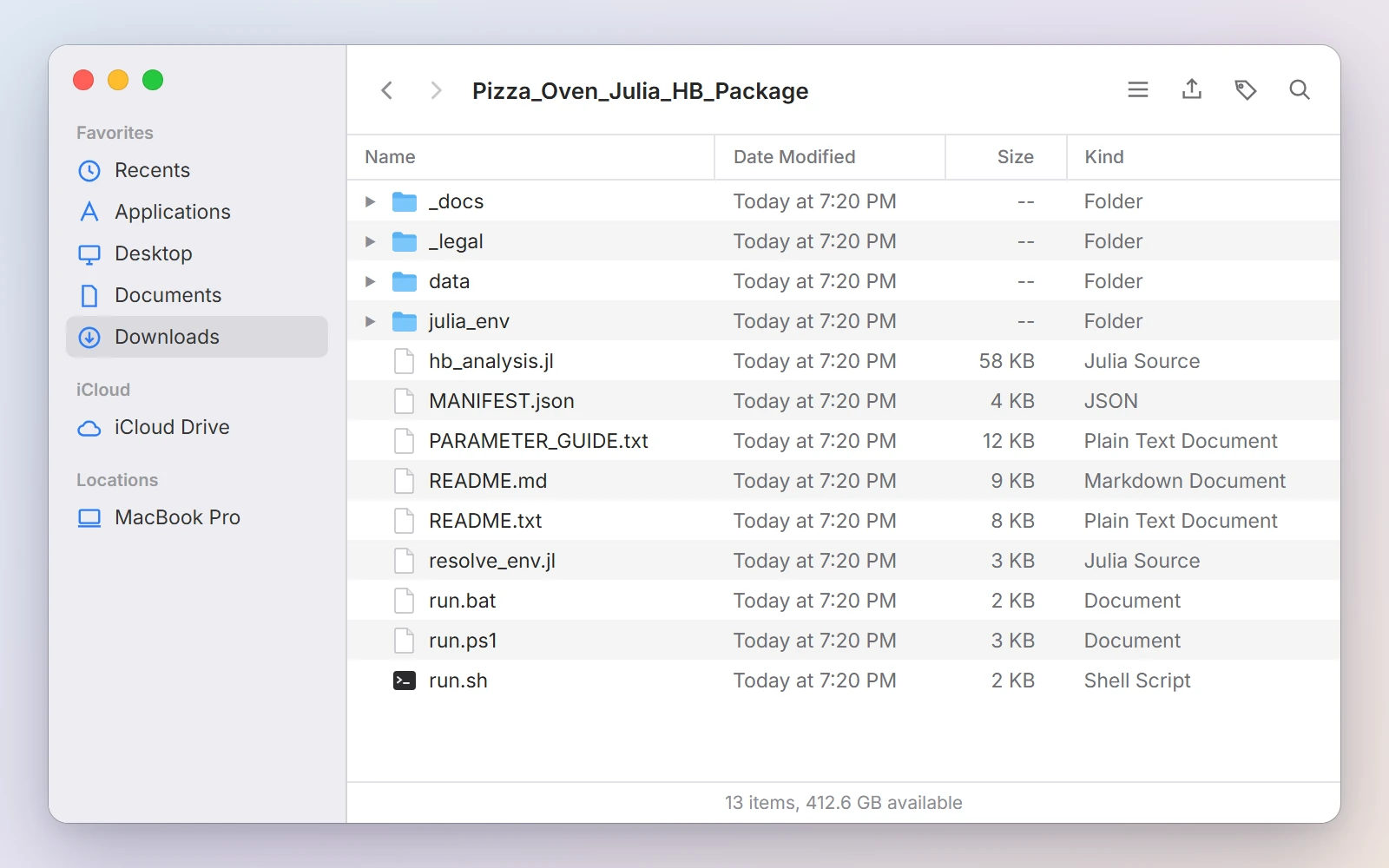
Export clean data, generate reports for stakeholders, or download the entire analysis as a self-contained replication package that anyone can re-run without Choicery.
- Excel (XLSX) reports with utilities, importance, hit rates
- Analysis-ready CSV and SPSS (.sav) exports: one clean header row and a codebook, no cleanup pass before analysis
- Direct data link for Power BI and Excel: paste the ready-made Power Query code once, then every refresh loads the latest responses. Google Sheets connects with your Google account and updates itself about every hour, with no code. The same token-secured API delivers CSV and JSON to R, Python and other tools
- Publication-ready PDF reports, chart PNGs and APA-style tables
- Julia (HB) & Python (Profile Analysis, Latent Class, Interaction Search) replication packages with script, data, a pinned environment and a launcher
- Parameter guide explaining every setting
Experimental design and its diagnostics
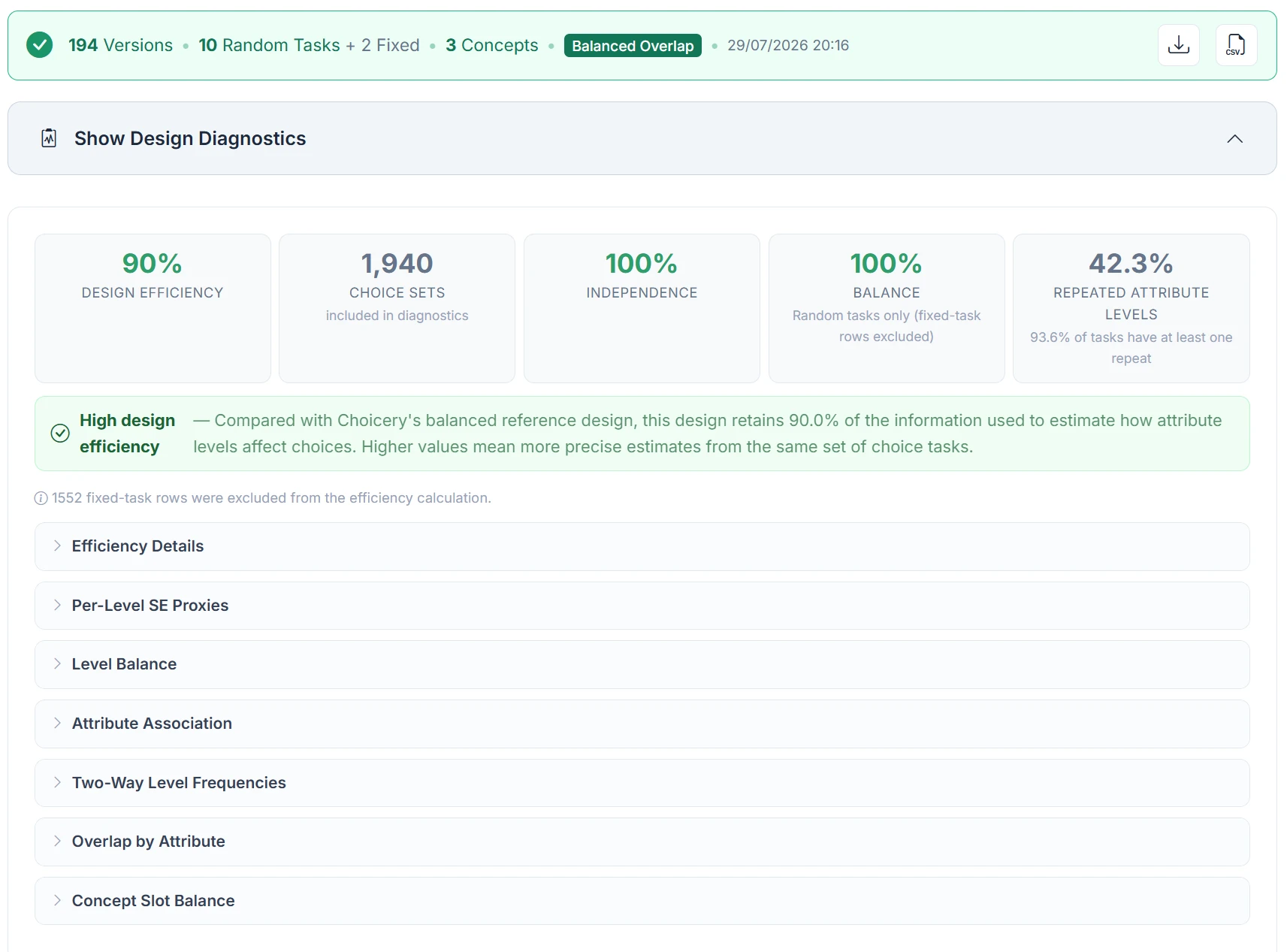
Underneath every conjoint study sits the experimental design: which product profiles appear together in which task. Choicery builds it for you, Balanced Overlap by default for robust main effects, or D-optimal when you want maximum efficiency for a specified model. Before the first respondent starts, the diagnostics show how much information the design carries.
- Design efficiency against a balanced reference design, plus D-efficiency and A-efficiency
- Level balance, attribute association, two-way level frequencies and overlap by attribute
- Prohibitions to forbid impossible level combinations
- Conditional pricing and conditional display for realistic tasks
- Multiple design versions with comparison
- Fixed and holdout tasks for validation
Inside the market simulator
Once a run finishes, the same individual utilities drive six tools: Choice Share, Willingness to Pay, Reservation Price, Price Elasticity, Sensitivity and Persona Simulation. The Market Simulation page explains each one with a recording from the app.
MaxDiff studies get their own simulator with TURF reach analysis and an assortment simulator.
Everything Choicery does
| Conjoint Types | ✓ CBC, CBC Shop, MaxDiff, Anchored MaxDiff, DR-CBC & BW-CBC |
|---|---|
| Advanced Analytics | ✓ Latent Class (with covariates), Profile Analysis, Neural HB & Interaction Search |
| HB Estimation | ✓ Julia multi-chain MCMC, R-hat & ESS diagnostics, sign constraints |
| Experimental Design | ✓ D-optimal designs, efficiency metrics, prohibitions, holdout tasks |
| Survey Builder | ✓ 15+ item types, skip & display logic, randomization, between-subjects |
| Market Tools | ✓ Choice share (3 methods), WTP (bootstrap), price elasticity, reservation price, sensitivity, persona simulation & TURF |
| Reports & Export | ✓ Excel, CSV, SPSS, Word, PDF, chart PNGs & APA-style tables, a direct data link for Power BI, Excel & Google Sheets, plus full Julia & Python replication packages |
| Data Integrity | ✓ HMAC-signed responses, audit logging & built-in bot protection |
Run your next conjoint study in Choicery
Try the full platform for free, and upgrade when your study needs more respondents.
No credit card required · Up to 50 respondents free · No fixed term